Are Tarantulas Poisonous? Bites, Venom and Urticating Hairs
Quick Answer
No. Tarantulas are venomous, not poisonous. They inject venom with their fangs, and a bite from a U.S. species feels much like a bee sting. For most people the bigger risk is the barbed hairs many American tarantulas flick, which can embed in skin and eyes.
Are Tarantulas Poisonous or Venomous?
Tarantulas are venomous. A poisonous animal harms you when you eat or touch it, while a venomous one injects toxin through a bite or sting.
Every tarantula has a pair of hollow fangs on its chelicerae, the jaw-like mouthparts. Zion National Park notes the venom subdues prey and helps digest it, but it is considered non-toxic to people.
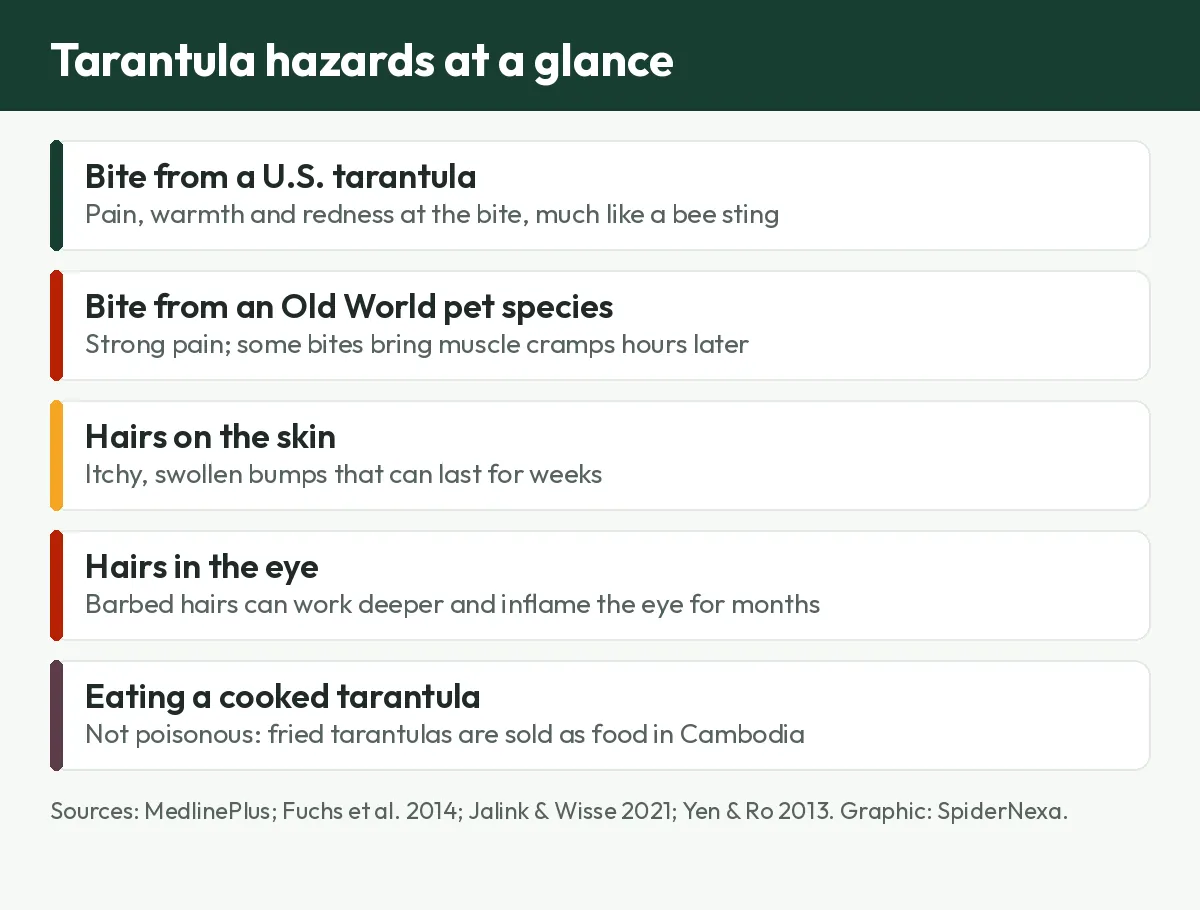
The body itself is not toxic. In Skun, Cambodia, known locally as “spider town,” fried tarantulas seasoned with salt, sugar and a garlic dip are sold as a snack. One vendor interviewed for a 2013 study sold 50 to 60 a day.
Can a Tarantula Bite Kill You?
No verified death from a tarantula bite has been documented. A systematic review published in Toxicon in November 2026 screened 42 bite reports from 1889 to 2026 and found none.
- Two deaths blamed on Chilobrachys tarantulas in a 1997 report from India lacked confirmation of the spider or the cause.
- Only 8 of the 42 reports had the spider identified by a named expert or lab.
- No antivenom has been validated, so treatment targets symptoms.
The review also warns that published cases are skewed toward unusual bites. That cuts both ways: mild bites go unreported, and severe ones get written up.
What Does a Tarantula Bite Feel Like?
A bite from a U.S. tarantula usually feels like a bee sting. MedlinePlus describes pain at the bite with warmth and redness, and Oklahoma State University rates the bite as no more harmful than a sting.
The fangs are large, so expect visible punctures. The national Poison Control center says the throbbing can last for hours, while fever, nausea and vomiting are rare.
Arachnologist Rod Crawford of the Burke Museum was once bitten by a Texas species. In his words, he “hardly even felt it.”
Can you be allergic to a tarantula bite?
Yes, but it is very rare. MedlinePlus lists breathing trouble, swelling of the lips or throat, skin rash and collapse as signs of an allergic reaction, and any of those needs emergency care.
Do Tarantulas Bite People Often?
No. Tarantulas bite when grabbed, squeezed or cornered, and bites are uncommon even among keepers. Many give a clear warning first.
- Threat pose: the spider rears back and lifts its front legs, showing the fangs.
- Hair flicking: American species brush hairs off the abdomen with their back legs.
- Feeding mix-ups: a spider expecting food can mistake a finger for prey.
Most wild tarantulas you meet in the U.S. are wandering males. Oklahoma State notes they roam from June to October in search of females, peaking in June and September, while females stay near their burrows.
Are Some Tarantulas More Dangerous Than Others?
Yes. Old World tarantulas from Africa, Asia and Australia tend to have stronger bites than New World species from the Americas, including all 29 U.S. species. Those all belong to one genus, Aphonopelma.
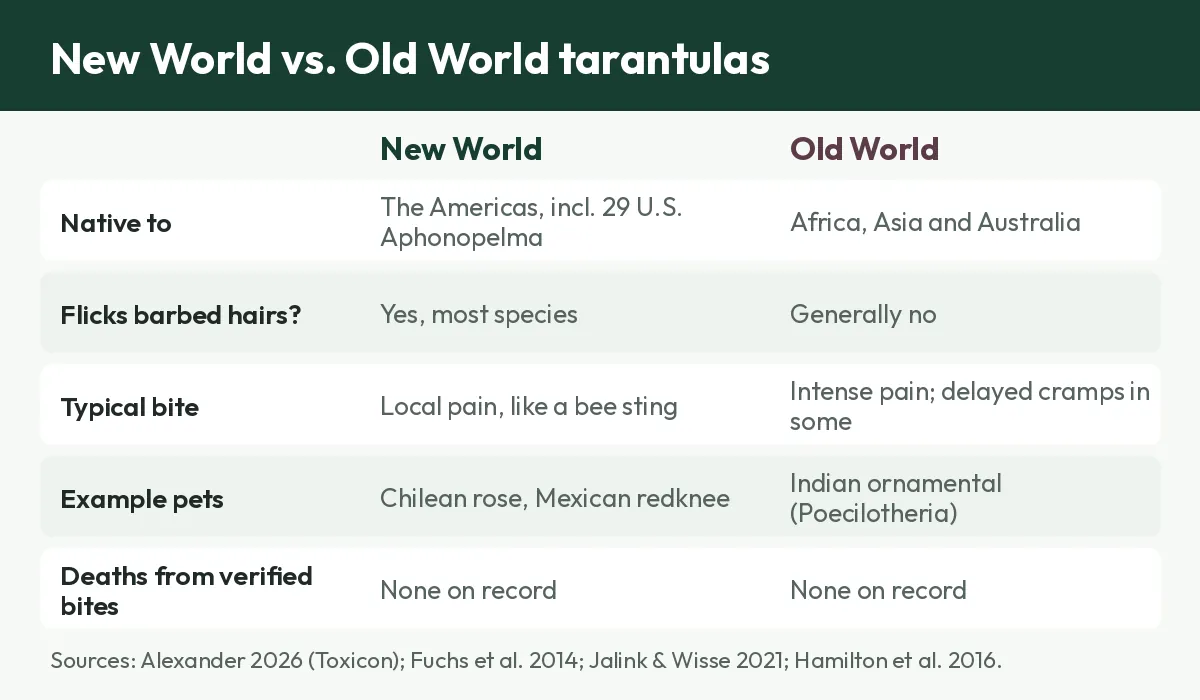
Indian ornamental tree spiders (Poecilotheria) are the best-documented example. A 2014 report described a verified bite in Switzerland that brought severe muscle cramps about 15 hours later, lasting three weeks.
- Across reviewed Poecilotheria bites, cramps began about 10 hours after the bite on average.
- In a 2025 Sri Lankan hospital series, only 4 of 17 patients bitten by spiders identified as Poecilotheria developed cramps.
- Australian tarantula bites caused severe local pain but no cramping, according to the 2026 review.
The pattern matters for pet owners. A delayed reaction is easy to miss, so anyone bitten by an Old World species should note the time and tell a doctor the spider’s name.
Why Are Tarantula Hairs the Bigger Risk?
For most people, hairs cause more lasting harm than bites. Many American tarantulas carry patches of barbed urticating hairs on the abdomen and kick them loose when threatened.
On skin, the barbs raise swollen, itchy bumps that MedlinePlus says can itch for weeks. In the air, the hairs can reach the nose and eyes, and the Burke Museum calls them the only health hazard of common pet tarantulas.
The same trick works on wildlife. Zion National Park describes a coyote that noses too close and ends up with a face full of stinging hairs.
What Happens if Tarantula Hairs Get in Your Eye?
They can burrow in. Barbs angled along each hair let it creep deeper over weeks, a condition doctors call ophthalmia nodosa.
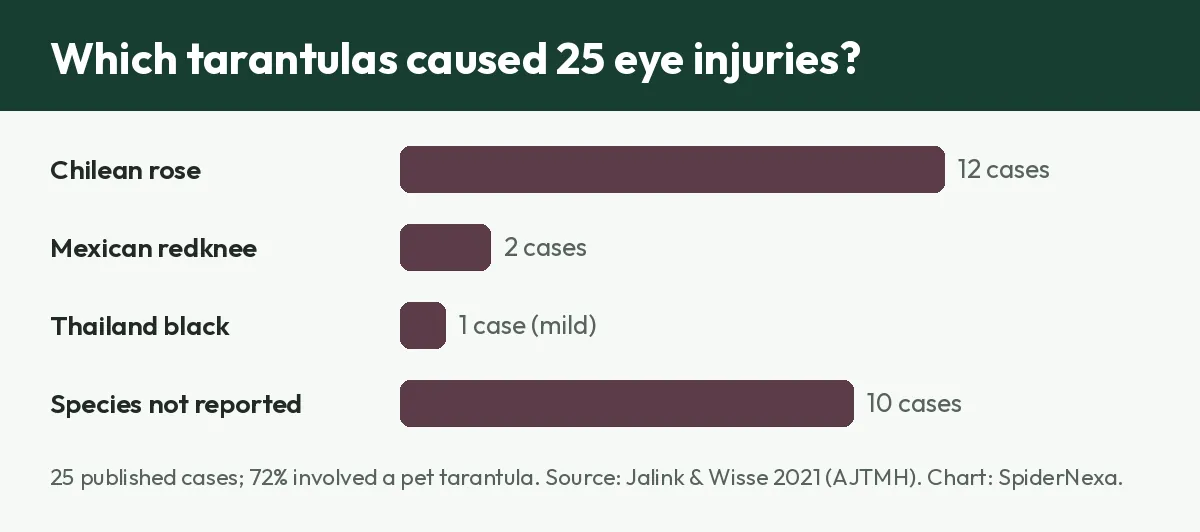
A 2021 review in the American Journal of Tropical Medicine and Hygiene collected 25 published cases. Most were young people, average age 16.8, and 72% involved a pet tarantula.
- Hairs in the cornea cause redness, pain and a gritty, sand-in-the-eye feeling.
- Over 2 to 9 weeks, some move into the front chamber of the eye and inflame it.
- A few reach the retina; hairs can stay visible for up to 12 months.
- One case involved a patient who only touched a shed skin, or molt.
Outcomes vary. In a 1997 BMJ report, two of three patients still had active eye inflammation at 24 and 72 months, and one had reduced vision.
A 2016 case in the Canadian Medical Association Journal shows how fast it happens. A 3-year-old held a Chilean rose tarantula at a birthday party and began rubbing his eye within seconds. He recovered full vision, but hairs were still visible in his cornea a year later.
Do Wild U.S. Tarantulas Have Irritating Hairs?
Yes, but they carry the mildest type. Native U.S. tarantulas are all Aphonopelma, a genus with only type I urticating hairs, according to a CITES identification guide.
A 2013 study of tarantula hairs in Zoologia describes type I hairs as only weakly irritating to humans, compared with type III. Reversed barbs keep them from sinking deep into skin.
Popular Latin American pets such as Brachypelma carry both type I and type III. Mild still is not harmless, though: Colorado State University Extension says the hairs of native species still itch badly and can hurt eyes.
Are Tarantulas Dangerous to Dogs and Cats?
They can be, and the clearest evidence is grim. In an Australian study, nine people bitten by local tarantulas had no major effects, yet all seven bitten dogs died, some within 30 minutes to 2 hours.
Those were Australian species (Selenocosmia and Phlogiellus). We found no comparable case series for U.S. tarantulas, so keep dogs from pawing at one and call a vet if a pet is bitten or gets hairs in its face.
What Should You Do After a Bite or Hair Exposure?
Clean the area, ease the pain and get advice. For any bite or exposure, Poison Help is toll-free at 1-800-222-1222.
| Exposure | What to do |
|---|---|
| Bite | Wash with soap and water. Apply a wrapped cold pack 10 minutes on, 10 minutes off. Call Poison Help. |
| Old World species bite | Do the same, note the time and species, and see a doctor if cramps, sweating or chest pain start. |
| Hairs on skin | Press sticky tape on the area and peel it off. Repeat, then wash with soap and water. |
| Hairs in the eye | Do not rub. See an eye doctor the same day and mention the tarantula. |
| Allergy signs | Call 911 for breathing trouble or swelling of the lips or throat. |
Eye exams need a slit lamp to spot the tiny hairs. The 2021 review advises follow-up for at least a year, since hairs can keep moving after symptoms fade.
How Can Pet Keepers Avoid Bites and Hairs?
Handle tarantulas as little as possible. The CITES guide advises against handling any species, both for your safety and the spider’s.
- Wear goggles and gloves when cleaning the enclosure or moving a spider.
- Use long tongs at feeding time so a finger never looks like prey.
- Treat shed skins as hairy, too, and keep them away from your face.
- Wash hands after any contact, and keep children’s faces away from the spider.
Curious how a tarantula uses that venom on prey? See what tarantulas eat in the wild. For a spider with the same “venomous, not poisonous” label, read whether huntsman spiders are poisonous.
Zion National Park says wild females can live up to 25 years. Our spider lifespan guide compares them with other spiders.
Related Guides
- All tarantula articles
- SpiderNexa home: common spiders in the U.S.
- Do Wolf Spiders Make Webs? What They Build Instead
- Are Orb Weaver Spiders Poisonous? What a Bite Really Does
- How to Identify a Brown Recluse Spider: The 5-Point Check
- How Long Do Spiders Live? Lifespans by Spider Type
- Can Jumping Spiders Bite? What Happens and How Rare It Is
- Are Huntsman Spiders Poisonous? Bite Facts for U.S. Homes
- What Do Tarantulas Eat? Wild U.S. Diet, Rare Prey and Pet Care
- Six-Spotted Fishing Spider: How Dolomedes triton Hunts on Water
- What Do Wolf Spiders Eat? Prey, Hunting and Pest Control
- What Do Jumping Spiders Eat? Wild Prey, Nectar and Pets
- How Long Do Orb Weavers Live? Their One-Year Life Cycle
- Where Do Huntsman Spiders Live in the U.S.? State-by-State
- Spider types: six common groups compared
- How to identify a spider in five steps
- Spider facts with sources
- All SpiderNexa articles
Tarantula Bite and Venom FAQ
Do tarantulas have venom?
Yes. All tarantulas are venomous and use it to subdue prey. Venom from U.S. species is not considered dangerous to people.
Do tarantulas bite?
Yes, but rarely. They bite when handled roughly, trapped or mistaking a finger for food, and most rear up in a warning pose first.
Is a tarantula bite worse than a bee sting?
For U.S. species, it is usually about the same: local pain, warmth and redness. Some Old World pet species cause stronger pain and delayed cramps.
Can tarantula hairs blind you?
Lasting vision loss is rare, but hairs can migrate inside the eye and cause months of inflammation. See an eye doctor promptly after any exposure.
Are tarantulas poisonous to eat?
No. Tarantulas are not poisonous, and fried tarantulas are sold as food in Cambodia.
References
- Alexander (2026), Theraphosid (tarantula) bite envenomation in humans: a systematic review of the reported epidemiology – Toxicon 109358
- Jalink & Wisse (2021), On the dangers of tropical spiders as a pet: a review of ocular symptoms caused by tarantula hairs – Am. J. Trop. Med. Hyg. 105(6):1795–1797
- Blaikie et al. (1997), Eye disease associated with handling pet tarantulas: three case reports – BMJ 314:1524
- Yang, Christakis & Mireskandari (2016), Acute conjunctivitis and corneal foreign bodies secondary to tarantula hairs – CMAJ 188(3):212
- Fuchs et al. (2014), A verified spider bite and a review of the literature confirm Indian ornamental tree spiders (Poecilotheria) as underestimated theraphosids of medical importance – Toxicon 77:73–77
- Isbister et al. (2003), Bites by spiders of the family Theraphosidae in humans and canines – Toxicon 41(4):519–524
- Bertani & Guadanucci (2013), Morphology, evolution and usage of urticating setae by tarantulas – Zoologia 30(4):403–418
- Cooper, West & Mendoza (2019), Identification of CITES-listed Tarantulas – Commission for Environmental Cooperation
- Hamilton, Hendrixson & Bond (2016), Taxonomic revision of the tarantula genus Aphonopelma within the United States – ZooKeys 560:1–340
- Yen & Ro (2013), The sale of tarantulas in Cambodia for food or medicine: is it sustainable? – Journal of Threatened Taxa 5(1):3548–3551
- Tarantula spider bite – MedlinePlus, U.S. National Library of Medicine
- Are tarantulas dangerous? – National Capital Poison Center
- Tarantula, Aphonopelma hentzi – Oklahoma State University Extension
- Tarantulas – Colorado State University Extension
- Myth: Tarantulas are dangerous to humans – Burke Museum
- Tarantulas – Zion National Park, National Park Service