
How to Identify a Brown Recluse Spider: The 5-Point Check
Quick Answer
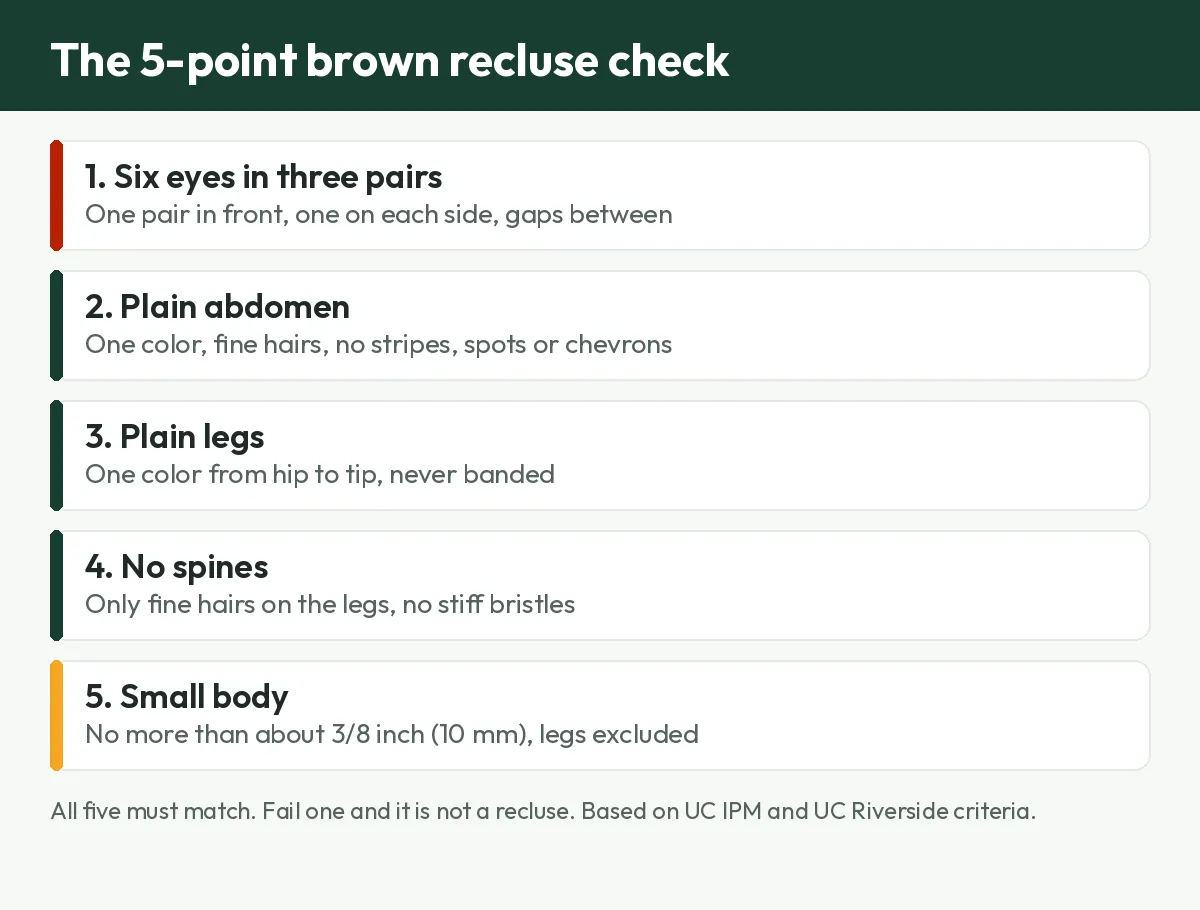
To identify a brown recluse, check five traits together: six eyes arranged in three pairs, a plain one-color abdomen, plain legs with no bands, no spines on the legs, and a body no longer than about 3/8 inch (10 mm). If any one trait fails, it is not a brown recluse. The violin mark alone is not reliable.
What Are the 5 Signs of a Brown Recluse?
A spider is a recluse only if it shows all five signs below. This all-or-nothing rule comes from University of California spider experts.
| Trait | Brown recluse | Common look-alike |
|---|---|---|
| Eyes | 6, in 3 pairs | 8 in two rows |
| Abdomen | One color, fine hairs | Spots, stripes or chevrons |
| Legs | One color, never banded | Banded or two-toned |
| Spines | None, only fine hairs | Stiff spines stick out |
| Body length | Up to about 3/8 in (10 mm) | Often larger |
How Do You Check the Eyes?
Look at the front of the head with a 10x hand lens or a phone camera zoomed in. A brown recluse has six eyes in three pairs: one pair in front and one pair on each side, with gaps between.
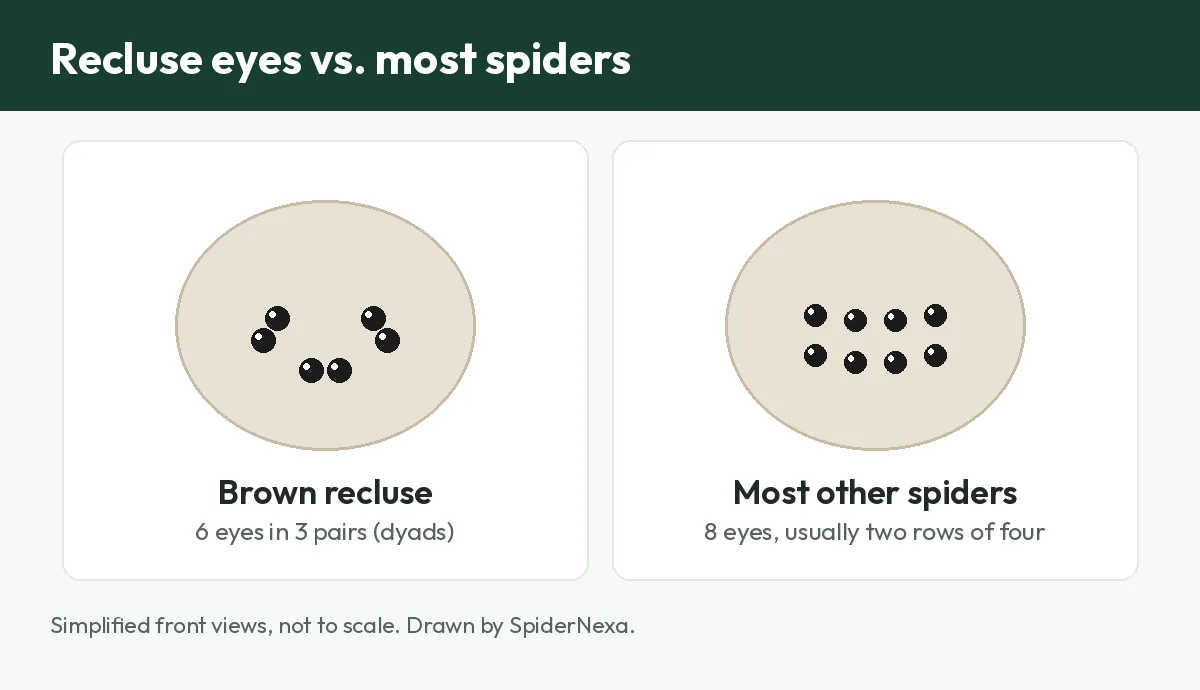
Most spiders have eight eyes, so this single check rules out nearly every suspect. Colorado State University calls it the quickest way to identify a recluse.
Spitting spiders (Scytodes) also have six paired eyes. They differ by having spotted or banded legs and a patterned body.
Why Isn’t the Violin Mark Enough?
The violin mark misleads because many harmless brown spiders have a similar dark shape on the head. In recluses, the mark can also be faint, especially in young spiders.
UC IPM notes that some southwestern recluse species have almost no violin at all. Use the mark as a hint, never as proof.
How Big Is a Brown Recluse?
A brown recluse body is up to about 3/8 inch (10 mm) long, not counting legs. With legs spread, an adult is roughly the size of a U.S. quarter.
A brown spider with a body clearly larger than a dime is probably something else, such as a wolf spider or a funnel weaver.
Where Do Brown Recluses Live?
Brown recluses live mainly in the south-central and lower Midwest states. They are common in parts of Kansas, Missouri, Arkansas, Oklahoma, Louisiana and Texas, and range east to Kentucky and Tennessee.
- They do not have breeding populations in California, according to UC IPM.
- Colorado State University says they are extremely rare in Colorado.
- The U.S. has 10 native recluse species, most near the Mexican border.
Location is powerful evidence. A 2005 study asked people nationwide to mail in spiders they thought were brown recluses.
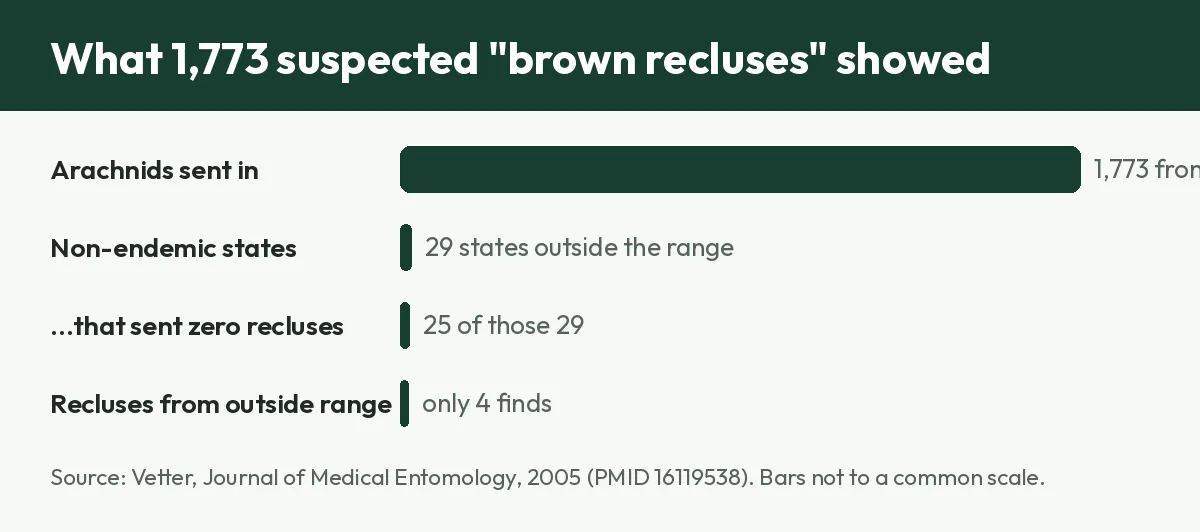
- 1,773 arachnids arrived from 49 states.
- In 25 of the 29 states outside the recluse range, not one recluse was submitted.
- Only four recluses came from outside known areas, two of them a different, introduced species.
If you live far outside the range, your spider is almost certainly not a recluse.
Do Brown Recluses Make Webs?
Yes, but small and hidden. Brown recluses spin loose, irregular retreat webs in dark spots such as boxes, closets, behind furniture and in basements.
They never build a web out in the open, between plants or across a doorway. A visible web like that belongs to another spider.
What Spiders Are Mistaken for Brown Recluses?
Funnel weavers and woodlouse hunters are the two groups most often mistaken for recluses, according to Colorado State University. Each fails at least one of the five checks.
- Funnel weavers and grass spiders: eight eyes, striped head, banded legs.
- Woodlouse hunter: six eyes, but clustered close together; red-orange head and legs; large fangs; often longer than 3/8 inch.
- Wolf spiders: larger, hairy, banded legs, eight eyes in a 4-2-2 pattern.
- Cellar spiders: very long thin legs and a small body.
- Pantropical huntsman: UF/IFAS notes it is sometimes taken for a large recluse, but its body is about 1 inch long, with eight eyes and sideways legs; see where huntsman spiders live in the U.S.
For a broader method, use our five-step spider identification guide.
How Often Do Brown Recluses Bite?
Bites are uncommon even where recluses are plentiful. A Kansas family collected 2,055 brown recluses in their home over six months, with at least 400 large enough to bite, and no one was bitten.
Many skin wounds blamed on recluses have other causes, such as infections. If you think you were bitten, see a doctor and, if possible, bring the spider.
Related Guides
- Where Do Huntsman Spiders Live in the U.S.? State-by-State
- Do Wolf Spiders Make Webs? What They Build Instead
- Are Orb Weaver Spiders Poisonous? What a Bite Really Does
- How Long Do Spiders Live? Lifespans by Spider Type
- Can Jumping Spiders Bite? What Happens and How Rare It Is
- Are Huntsman Spiders Poisonous? Bite Facts for U.S. Homes
- What Do Tarantulas Eat? Wild U.S. Diet, Rare Prey and Pet Care
- Six-Spotted Fishing Spider: How Dolomedes triton Hunts on Water
- Spider types: six common groups compared
- How to identify a spider in five steps
- Spider facts with sources
- All SpiderNexa articles
Frequently Asked Questions
What is the easiest way to tell if a spider is a brown recluse?
Count the eyes. A brown recluse has six eyes in three pairs, while most spiders have eight. If you see eight eyes, it is not a recluse.
Can a brown recluse have stripes or spots?
No. North American recluses have a plain abdomen and plain legs. Any stripes, spots or leg bands mean it is a different spider.
Are brown recluses aggressive?
No. They are shy and hide during the day. Most bites happen when a spider is pressed against skin, for example inside clothing or bedding.
What should I do if I find a brown recluse?
Catch it in a jar if you can do so safely and confirm the eyes. Reduce clutter, shake out stored clothing and shoes, and use sticky traps in basements and closets.
References
- Brown Recluse and Other Recluse Spiders – UC IPM
- How to Identify and Misidentify a Brown Recluse Spider – UC Riverside Spider Research
- Brown Recluse Spiders in Colorado: Recognition and Spiders of Similar Appearance – Colorado State University Extension
- Vetter (2005), Arachnids submitted as suspected brown recluse spiders – Journal of Medical Entomology
- Vetter & Barger (2002), An infestation of 2,055 brown recluse spiders and no envenomations in a Kansas home – Journal of Medical Entomology
- Brown Recluse Spider (EF631) – University of Kentucky Entomology