Can Jumping Spiders Bite? What Happens and How Rare It Is
Quick Answer
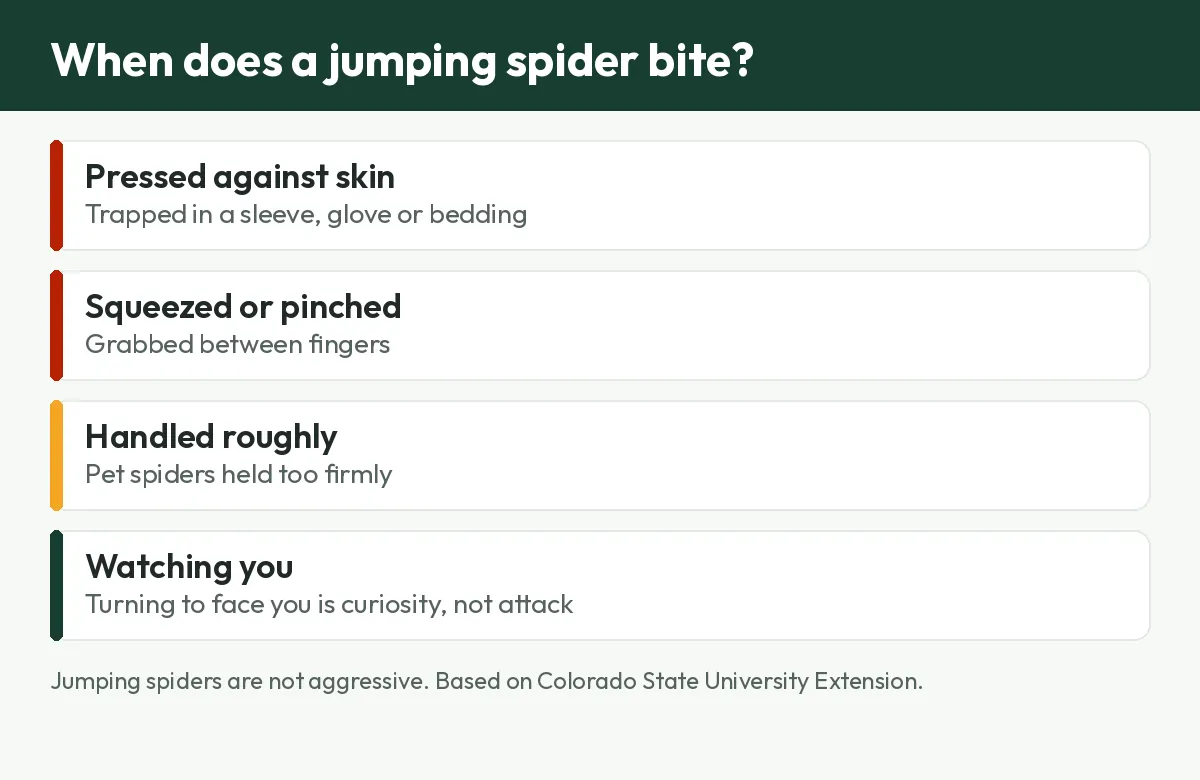
Yes, jumping spiders can bite, but they very rarely do. They bite only when trapped against skin or squeezed, and most species have fangs too tiny to get through human skin. When a bite does happen, it usually causes brief, mild pain and a small red bump.
Do Jumping Spiders Bite People?
Rarely. Colorado State University Extension says jumping spiders are not aggressive and try to bite only if confined.
They are curious instead. A jumping spider will often turn to face a person and may even walk toward them, which people mistake for aggression.
Which Jumping Spiders Can Break Skin?
Only the larger species have fangs big enough to pierce skin. Most jumping spiders are 4–12 mm long, and their jaws are too small.
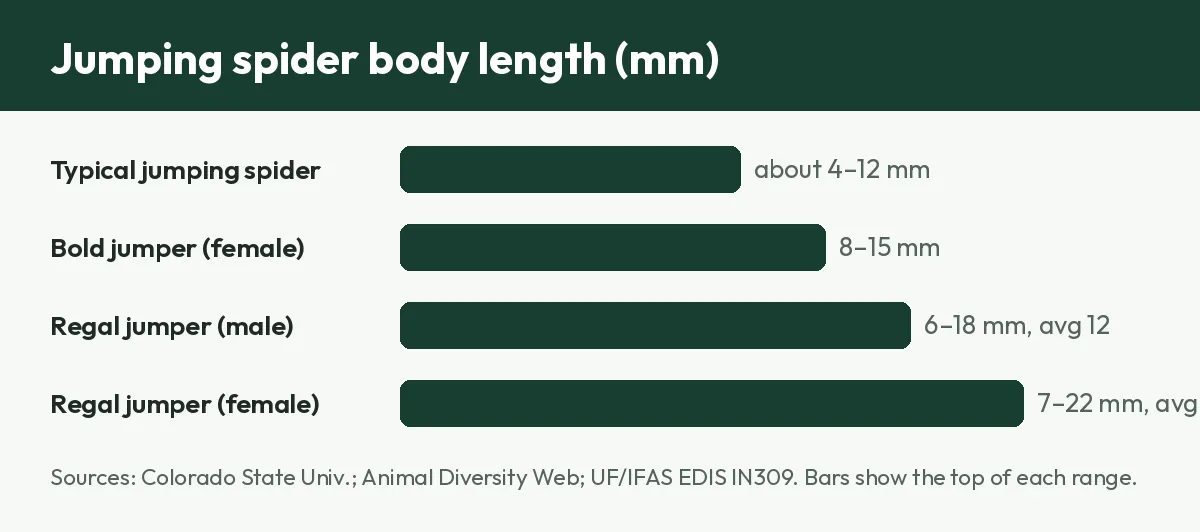
- Bold jumper (Phidippus audax): females 8–15 mm, common across North America.
- Regal jumper (Phidippus regius): the largest jumping spider in the eastern U.S.; females average 15 mm and reach 22 mm.
- Small species such as the zebra jumper: usually cannot break skin at all.
So a bite worth noticing almost always comes from a large Phidippus species.
Are Jumping Spiders Venomous?
Yes. Like nearly all spiders, jumping spiders have venom to subdue insects. Animal Diversity Web notes the bold jumper is venomous but its bite is not dangerous to humans.
“Venomous” is the right term. They are not poisonous to touch.
What Does a Jumping Spider Bite Feel Like?
Most people describe a quick pinch followed by mild, short-lived pain. A small red bump or mild itching may follow for a day or so.
Wider studies of identified spider bites support this. In a 2001 study of 34 confirmed spider bites in tropical Australia, four were from jumping spiders and none of the bites caused severe effects.
How Is It Different From a Dangerous Spider Bite?
A jumping spider bite stays mild and local. Bites from widow or recluse spiders behave differently and need medical attention.
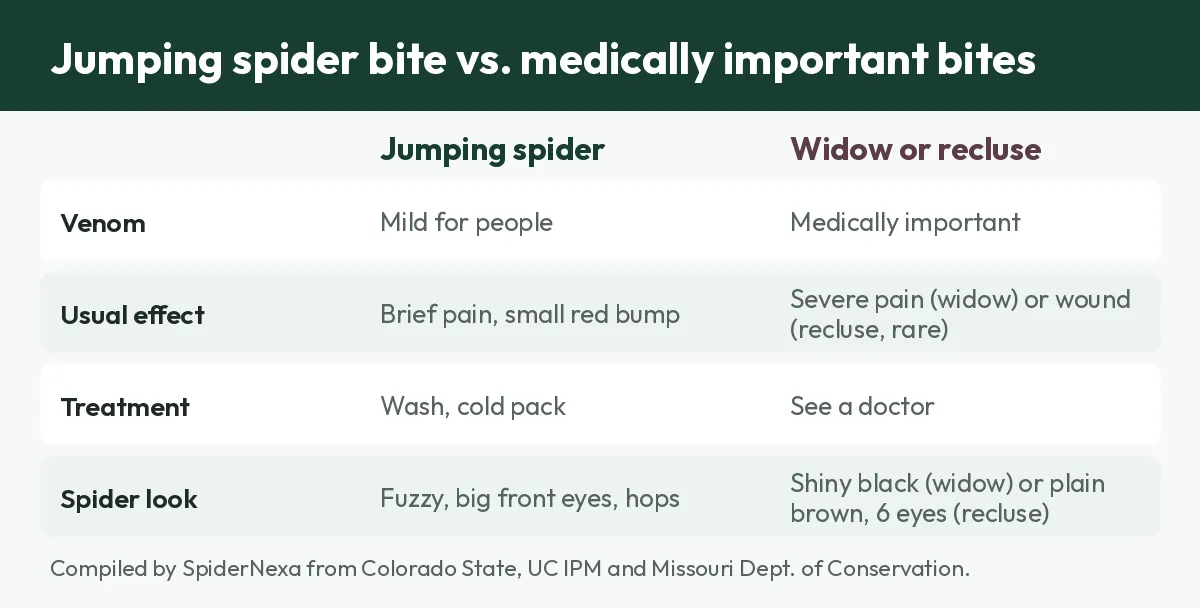
If you are not sure what bit you, check the spider’s eyes. Jumping spiders have two very large front eyes; see our eye pattern guide.
What Should You Do if a Jumping Spider Bites You?
- Wash the bite with soap and water.
- Apply a cold pack for about 10 minutes.
- Take an over-the-counter pain reliever if needed.
- Keep the area clean so it does not get infected.
Get medical care for trouble breathing, swelling of the face or throat, spreading redness, pus or fever.
Are Pet Jumping Spiders Safe to Handle?
Generally yes, if handled gently. Let the spider walk onto your hand instead of picking it up, and never squeeze it.
Bites in captivity usually happen when a spider is pinned or startled. Short, calm sessions keep both you and the spider safe.
Feeding time needs the same care. See what jumping spiders eat for safe prey sizes and vet feeding schedules.
Related Guides
- What Do Jumping Spiders Eat? Wild Prey, Nectar and Pets
- Do Wolf Spiders Make Webs? What They Build Instead
- Are Orb Weaver Spiders Poisonous? What a Bite Really Does
- How to Identify a Brown Recluse Spider: The 5-Point Check
- How Long Do Spiders Live? Lifespans by Spider Type
- Are Huntsman Spiders Poisonous? Bite Facts for U.S. Homes
- What Do Tarantulas Eat? Wild U.S. Diet, Rare Prey and Pet Care
- Six-Spotted Fishing Spider: How Dolomedes triton Hunts on Water
- Spider types: six common groups compared
- How to identify a spider in five steps
- Spider facts with sources
- All SpiderNexa articles
Jumping Spider Bite FAQ
Can a bold jumping spider bite you?
Yes, but only if pressed or held. Bold jumpers are large enough to break skin, yet the bite usually causes only mild pain and redness that fades quickly.
Are all jumping spiders harmless?
For healthy people, yes. No jumping spider in North America is considered medically dangerous. As with any bite, a rare allergic reaction is possible.
Why does a jumping spider look at me?
Jumping spiders have excellent vision and turn their large front eyes toward anything that moves. It is checking you out, not preparing to attack.
Should I kill a jumping spider in my house?
There is no need. Jumping spiders eat flies and other small insects. Move it outside with a cup and a sheet of paper.
References
- Jumping Spiders – Colorado State University Extension
- Phidippus audax – Animal Diversity Web, University of Michigan
- Regal Jumping Spider, Phidippus regius – UF/IFAS EDIS (IN309)
- Isbister et al. (2001), Clinical effects of bites from formally identified spiders in tropical Northern Territory – Medical Journal of Australia
- Isbister & Gray (2002), A prospective study of 750 definite spider bites – QJM