How Long Do Orb Weavers Live? Their One-Year Life Cycle
Quick Answer
Most U.S. orb weavers live roughly one year. They leave the egg sac in spring, grow all summer, breed in early fall and die once hard freezes set in. Their eggs or spiderlings wait out winter in the sac.
How Long Do Orb Weavers Live?
Orb weavers (family Araneidae) usually live about one year, and few survive to a second summer. Extension entomologists in Kentucky, Utah and Florida all describe a single season of life followed by death before winter.
How you count matters. In the yellow garden spider, eggs hatch in fall, yet the young rest, dormant, within the sac until spring. Counted from hatching, a typical one survives slightly more than 12 months, from fall hatching to the next year’s hard frost.
| Orb weaver | Typical lifespan | How it spends winter |
|---|---|---|
| Yellow garden spider (Argiope aurantia) | Just over 12 months from hatching | Dormant spiderlings within the sac |
| Marbled orb weaver (Araneus marmoreus) | About 1 year | Eggs in sacs tucked among leaves and twigs |
| Golden silk spider (Trichonephila clavipes) | About 1 year | Young spiderlings in the sac for 6–8 months |
| Joro spider (Trichonephila clavata) | About 1 year | Eggs in a single fluffy sac |
| Furrow spiders (Larinioides) | Can exceed 1 season | Some overwinter as adults |
What Does the Orb Weaver Life Cycle Look Like?
The orb weaver life cycle runs on one generation per year, timed to the seasons. Clemson, NC State and UGA all report a single generation annually for the big garden and joro spiders.
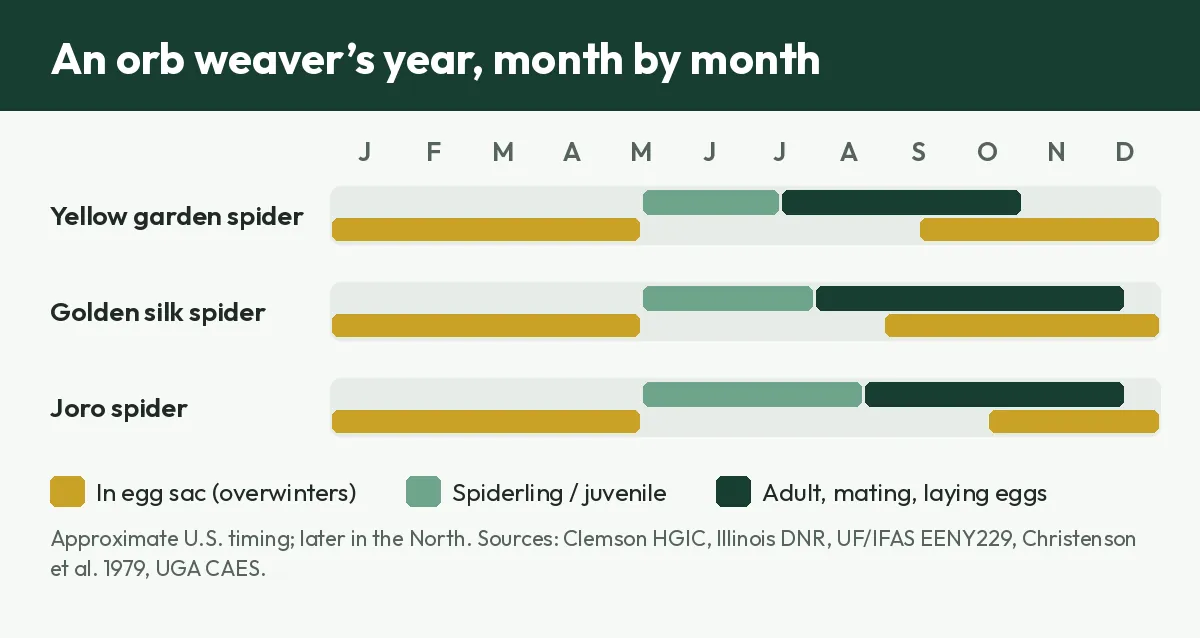
- Spring: spiderlings leave the egg sac, usually in April or May, and many disperse by ballooning on wind-borne silk.
- Early summer: juveniles spin small, easy-to-miss webs and molt as they grow.
- Late summer: males mature first and go looking for females; females reach full size.
- Fall: females lay eggs in silk sacs, then weaken as nights get colder.
- Winter: the adults have died; their egg sacs carry on.
That is why big orb webs seem to appear suddenly in September. The spiders were there all summer, just small.
Why Do Orb Weavers Die in the Fall?
Cold weather ends their single season, and by then the next generation is already safe in the egg sac. Animal Diversity Web notes that a yellow garden spider female is killed by the first hard frost at the latest.
Cold slows them first. Mississippi State Extension describes female marbled orb weavers left sitting in the open on chilly fall mornings, too sluggish to return to their daytime hiding spots.
Age shows in their webs, too. In a lab study of a common European orb weaver, spiders close to death traveled less while building and spun smaller webs with less silk.
Do Orb Weaver Spiders Die After Laying Eggs?
Yes, in most species the female dies after her last egg sac, either soon afterward or when hard freezes arrive. Some lay only one sac; others make several before they die.
| Species | Egg sacs per female | Eggs per sac | After laying |
|---|---|---|---|
| Yellow garden spider | 1 to 4 | 300–1,400 | Guards the sac until frost kills her |
| Golden silk spider | 1 to 3 | Several hundred | Abandons the sac; dies by mid-December |
| Joro spider | 1 | About 400–500 | Killed off by hard freezes |
| Spiny orb weaver | 1 egg mass | 100–260 | Dies after producing it |
The joro schedule can stretch a little. UGA reports that during mild autumns, some females hang on until December.
How Long Do Male Orb Weavers Live?
Male orb weavers usually live shorter lives than females. They mature earlier, often abandon their own webs, and spend their adult weeks searching for mates.
- Yellow garden spider: in lab and field matings, every male that inserted his second pedipalp became motionless, and his heartbeat stopped within minutes.
- Golden silk spider: males die by late September, while females last until mid-December.
- Spiny orb weaver: Galveston County Master Gardeners report males die about six days after mating.
The garden spider result is striking because the female did not cause it. Researchers Foellmer and Fairbairn showed the death is triggered by the male’s own mating act.
How Do Orb Weaver Egg Sacs Survive the Winter?
Egg sacs survive winter by wrapping eggs or tiny spiderlings in layers of tough silk, often hung in the web or stuck to bark, leaves or siding. The silk walls act as barriers against many predators and parasites.
- Golden silk spiderlings wait in the sac for six to eight months before emerging in spring.
- Hanging the sac in the web helps protect it from ants.
- Birds still damage most yellow garden spider sacs over winter.
- One study found 19 insect species and 11 spider species emerging from yellow garden spider egg cases, including egg parasites and predators.
Survival is low as a result. NC State Extension says only a small share of spiderlings make it to spring, and fewer still grow into adults.
Which Orb Weavers Live Longer Than a Year?
A few orb weavers break the one-season rule, mostly by surviving winter as adults. These are the exceptions worth knowing in the U.S.
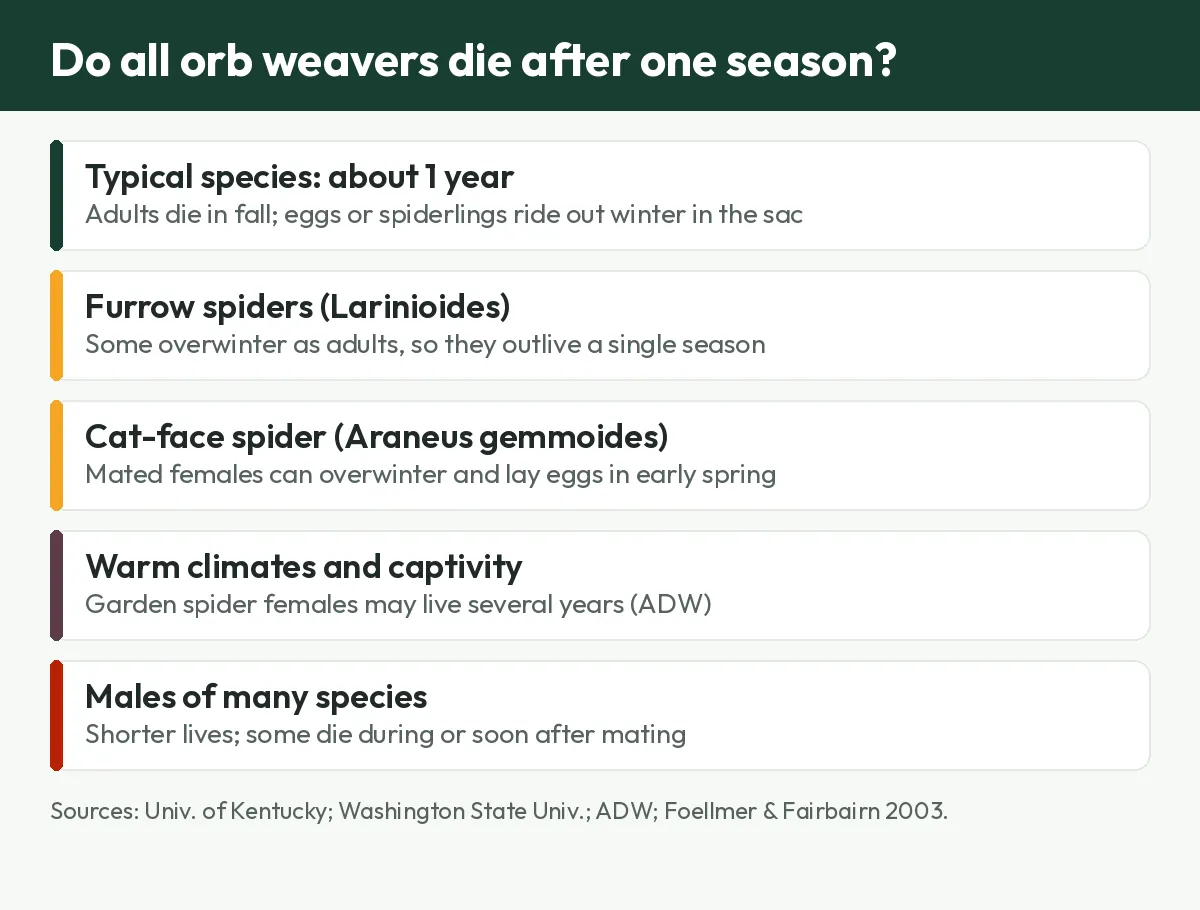
- Furrow spiders (Larinioides): the University of Kentucky notes some overwinter as adults, which is unusual for orb weavers.
- Cat-face spider (Araneus gemmoides): a Washington State University entomologist reports mated, egg-bound females overwintering, then laying eggs in early spring.
- Warm climates and captivity: Animal Diversity Web says yellow garden spider females may live several years there.
So if you see an adult orb weaver in January, it is probably one of these overwintering types. In cold regions, a big garden spider that late is very unlikely.
How Long Do Joro Spiders Live?
Joro spiders live about one year, like native orb weavers. UGA describes one generation per year, with sacs laid during October–November and young emerging around May in Georgia.
What differs is cold tolerance. A 2022 study compared female joros with golden silk spiders, their established cousin in the Southeast.
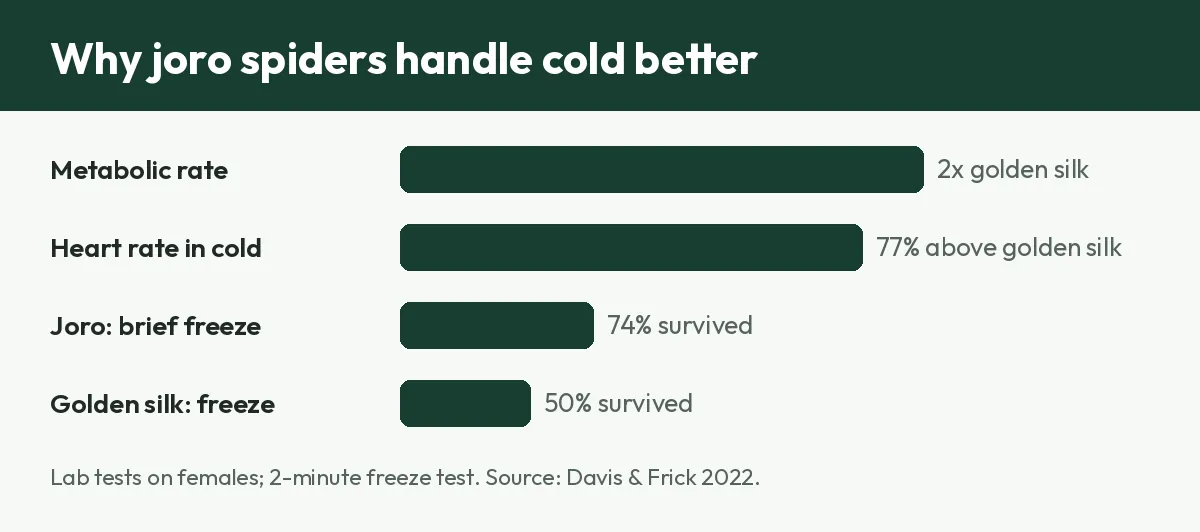
Joros also have a shorter season, so they can finish their year in a narrow warm window. The authors concluded the joro can likely live in colder regions than the southeastern U.S.
Should You Remove an Orb Weaver’s Egg Sac?
Leave native orb weaver egg sacs alone, because the spiders are beneficial predators of flying insects. Kentucky and Utah State Extension both call orb weavers beneficial, and neither treats them as a health hazard.
Joro egg sacs are the one case experts flag. UGA calls scraping joro sacs from walls, eaves, fence boards or tree bark between November and April the highest-value step for cutting next year’s numbers.
Not sure whether a spider’s bite matters? See whether orb weavers are poisonous for the bite research.
How Does Orb Weaver Lifespan Compare With Other Spiders?
Orb weavers sit at the short end of spider lifespans. Brown recluses often live 2–4 years, and female tarantulas can reach about 25 years.
The difference comes down to biology and shelter. Long-lived spiders keep molting as adults or hide in burrows, while orb weavers live exposed in webs. Our guide on how long spiders live compares the main groups.
Browse more orb-weaver spider guides or other common spider types.
Related Guides
- All orb-weaver spider articles
- SpiderNexa home: common spiders in the U.S.
- Do Wolf Spiders Make Webs? What They Build Instead
- Are Orb Weaver Spiders Poisonous? What a Bite Really Does
- How to Identify a Brown Recluse Spider: The 5-Point Check
- How Long Do Spiders Live? Lifespans by Spider Type
- Can Jumping Spiders Bite? What Happens and How Rare It Is
- Are Huntsman Spiders Poisonous? Bite Facts for U.S. Homes
- What Do Tarantulas Eat? Wild U.S. Diet, Rare Prey and Pet Care
- Six-Spotted Fishing Spider: How Dolomedes triton Hunts on Water
- What Do Wolf Spiders Eat? Prey, Hunting and Pest Control
- What Do Jumping Spiders Eat? Wild Prey, Nectar and Pets
- Spider types: six common groups compared
- How to identify a spider in five steps
- Spider facts with sources
- All SpiderNexa articles
Frequently Asked Questions
Does the same orb weaver come back to my porch every year?
No. For most species, the adult you saw last fall died that winter. Any orb weaver in the same spot next year is a new spider from the next generation.
What month do orb weavers die?
Most adults die between October and December, as hard freezes arrive. Golden silk females last until about mid-December, while their males are usually gone by late September.
How many eggs does an orb weaver lay?
It varies by species. Yellow garden spider sacs hold about 300–1,400 eggs, joro sacs about 400–500, and a spiny orb weaver egg mass about 100–260.
Do garden spiders live more than one year?
Usually not in the U.S. outdoors. Counted from fall hatching, most yellow garden spiders survive just over a year, though females may live longer in warm climates or captivity.
Are orb weavers active in winter?
Mostly no. Across most of the U.S., adults have died by winter, leaving just their egg sacs. The main exceptions are furrow spiders and some cat-face females, which overwinter as adults.
References
- Stevenson, Weekly “What is it?”: Orb Weaver Spiders – UF/IFAS Extension Escambia County
- Newton, Orb-Weaver Spiders – University of Kentucky Entomology Critter Files
- Hammond, Argiope aurantia – Animal Diversity Web, University of Michigan Museum of Zoology
- Baker, Black and Yellow Garden Spider – NC State Extension
- Big Yellow Spiders in South Carolina – Clemson Home & Garden Information Center, HGIC 2503
- Black-and-yellow garden spider – Illinois Department of Natural Resources
- Layton, Marbled Orb Weaver – Mississippi State University Extension, Bug’s Eye View 9(31)
- Weems & Edwards, Golden Silk Spider, Trichonephila clavipes – UF/IFAS EENY229
- Christenson, Wenzl & Legum (1979), Seasonal variation in egg hatching and certain egg parameters of the golden silk spider – Psyche 86
- Foellmer & Fairbairn (2003), Spontaneous male death during copulation in an orb-weaving spider – Proc. R. Soc. B (Biology Letters) 270
- Anotaux et al. (2016), Time till death affects spider mobility and web-building behavior in an orb-web spider – Current Zoology 62(2)
- Davis & Frick (2022), Physiological evaluation of newly invasive jorō spiders compared to Trichonephila clavipes – Physiological Entomology 47(3)
- Joseph, The Jorō Spider in Georgia (2026) – UGA CAES Turf and Ornamental Pest Management
- Joro Spider: Trichonephila clavata – UGA CAES Circular 1273
- Cat Face Spider – Washington State University Department of Entomology
- Spiny Orb Weaver Spider – Galveston County Master Gardeners (Texas A&M AgriLife)
- Orb Weaving Spiders – Utah State University Extension