Where Do Huntsman Spiders Live in the U.S.? State-by-State
Quick Answer
In the U.S., the pantropical huntsman spider lives where winters stay mild: Florida, the Gulf Coast, coastal Georgia and South Carolina, warm parts of California, and Hawaii. A separate, native huntsman, the giant crab spider, lives in the desert Southwest. Sightings outside those areas are nearly always cargo hitchhikers.
Where Do Huntsman Spiders Live in the U.S.?
Huntsman spiders live mainly in the southern third of the country and in Hawaii. Two groups account for nearly all of them, and they sit at opposite ends of the map.
- Southeast, Gulf Coast and Hawaii: the pantropical huntsman (Heteropoda venatoria), an introduced species.
- Desert Southwest: the giant crab spider (Olios giganteus) and a few smaller relatives, all native.
- Everywhere else: only short-lived arrivals in produce, crates and heated buildings.
Both belong to the family Sparassidae. They hunt on foot rather than in webs, and they hold their legs out sideways like a crab.
Which States Have the Pantropical Huntsman?
The pantropical huntsman is established in Florida, Texas, Louisiana, Mississippi, Alabama and California, plus coastal Georgia, coastal South Carolina and several Hawaiian islands. UF/IFAS, the Texas Invasive Species Institute and Bishop Museum records together cover these areas.
| State or area | Status | What the record shows |
|---|---|---|
| Florida | Established; wild in the far south | Lives in avocado groves near Homestead, not just buildings |
| Hawaii | Established, introduced | Recorded on Kauai, Oahu and Hawaii Island, plus Midway |
| Texas | Established | Listed by the Texas Invasive Species Institute |
| Louisiana, Mississippi, Alabama | Established along the Gulf | Listed by the Texas Invasive Species Institute |
| Georgia, South Carolina | Coastal areas | Named by UF/IFAS for the coast only |
| California | Subtropical areas | UC Irvine notes an Orange County male that arrived in a truck |
| Northern states | Not established | Occasional cargo arrivals; cannot live outdoors |
Mississippi is listed by the Texas institute but had no verified iNaturalist records when we checked. That gap likely reflects fewer observers, not proof the spider is absent.
What Do Verified Sightings Show?
Florida dominates. When we pulled every research-grade U.S. iNaturalist record of Heteropoda venatoria on 24 November 2026, Florida held 1,924 of 2,820, about 68%.
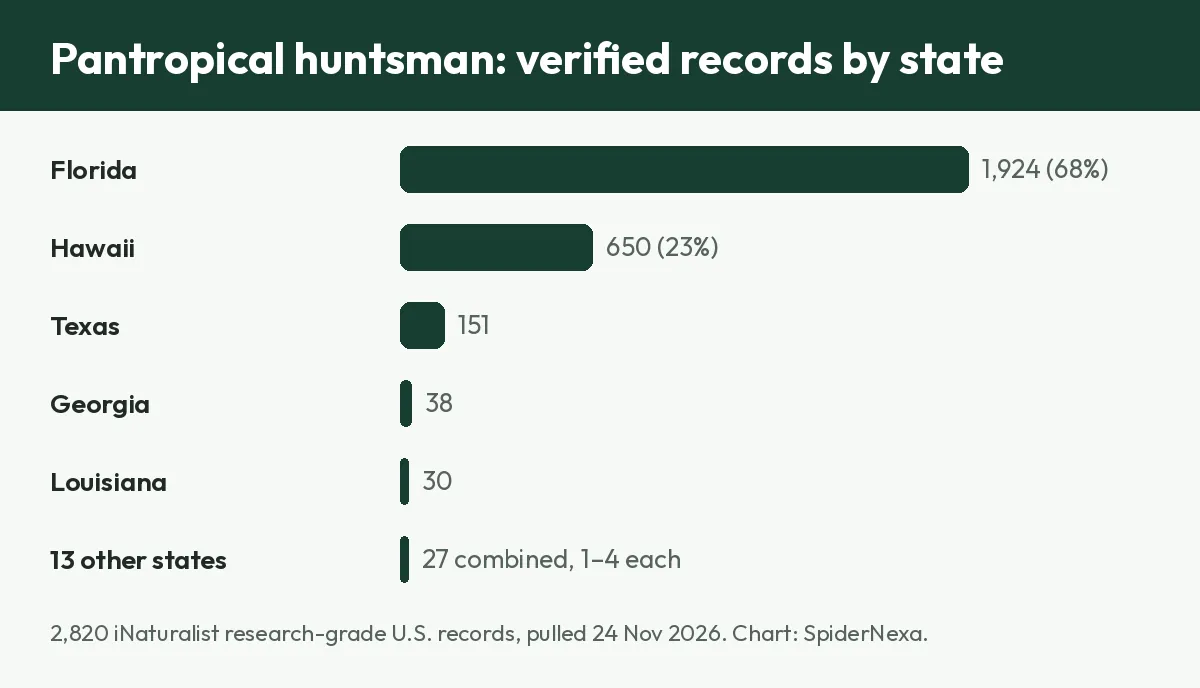
- Hawaii came second with 650 records, about 23%.
- Texas had 151, Georgia 38 and Louisiana 30.
- Thirteen other states shared 27 records, none with more than four.
- Ohio had zero verified records.
Research-grade means the record has a photo, date and place, and at least two identifiers agreed on the species. Records follow people with cameras, so a low count can mean few observers rather than few spiders.
Are There Native Huntsman Spiders in the U.S.?
Yes. The giant crab spider, Olios giganteus, is a native huntsman of the desert Southwest. The Arizona-Sonora Desert Museum says it occurs throughout Arizona and spends the day inside dead saguaros, beneath stones or in houses.
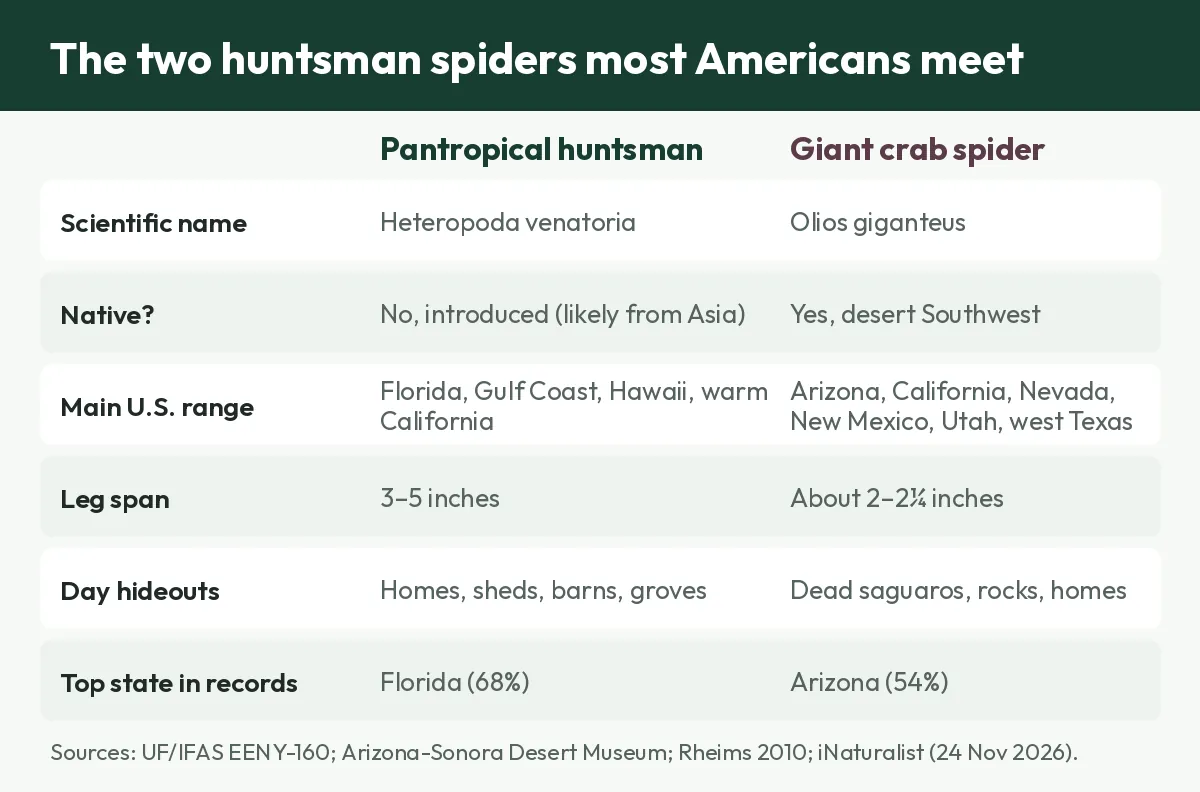
A 2010 revision of North American huntsman spiders examined specimens of this species from Arizona, California, Nevada, New Mexico, Texas and Utah. In iNaturalist, Arizona holds 2,396 of 4,426 verified U.S. records, about 54%.
The American Arachnological Society lists a handful of other native sparassids, in Arizona, California, New Mexico and Texas. One more species, Decaphora cubana, was described from Cuba and is listed for Florida.
Why the “giant crab spider” name confuses people
The same nickname gets used for both species. UF/IFAS notes the pantropical huntsman is sometimes called the giant crab spider, while the Desert Museum uses that name for Olios giganteus.
Neither one is a true crab spider. True crab spiders are much smaller and sit in another family, Thomisidae.
Do Huntsman Spiders Live in Hawaii?
Yes. A Bishop Museum catalog of Hawaiian spiders lists the pantropical huntsman as introduced, with records from Kauai, Oahu, Hawaii Island and Midway.
- A 1934 note in that catalog describes one found in a can of pineapples, first mistaken for a tarantula.
- A 1932 survey found none above 5,200 feet on Hawaii Island, likely a sign of its need for warmth.
- A 2017 night survey in Kāneʻohe, Oʻahu, called it the cane spider and found it common at lights.
Why Can’t Huntsman Spiders Survive in Cold States?
They cannot tolerate freezing. UF/IFAS describes the pantropical huntsman as cold-sensitive and unable to survive outside anywhere winter brings hard freezes.
In far southern Florida, which seldom sees frost, it has gone “wild” and lives away from buildings. Further north, it depends on shelter, which is why sightings cluster in houses, garages, sheds and greenhouses.
Are Huntsman Spiders in Ohio or Other Northern States?
Not as a resident population. A huntsman found in Ohio, New York or Minnesota most likely arrived with goods, such as bananas, and will not survive an outdoor winter.
The iNaturalist data fit this. Northern states such as Massachusetts, New York, Pennsylvania, Michigan, Minnesota and Wisconsin each had one to three verified records. That is a trickle of arrivals, not the hundreds seen in Florida.
How Do Huntsman Spiders Reach Northern States?
Mostly in imported produce. A study of 135 spiders found in international cargo and sent to North American arachnologists found the pantropical huntsman was the single most common, with 45 specimens.

- Bananas were the cargo most often involved, usually from Central America, Ecuador or Colombia.
- Huntsman spiders turned up year-round; the red-faced banana spider peaked in the first half of the year.
- Even with a fruit importer helping, the team received only about 8.5 spiders a year.
- None of the 135 spiders had bitten anyone.
The same study found experienced arachnologists sometimes mistook harmless banana spiders for dangerous Phoneutria. A photo sent to an expert beats a guess.
How Can You Tell a Huntsman From a Wolf Spider?
Watch how it moves and where it sits. A huntsman holds its legs out to the sides, runs sideways and climbs walls and ceilings, while a wolf spider stays on the ground.
| Clue | Huntsman | Wolf spider |
|---|---|---|
| Leg posture | Held out at right angles, crab-like | Pointed forward and back, not splayed sideways |
| Climbing | Climbs smooth walls and ceilings | Rarely climbs; a ground hunter |
| Body | Flattened, slips into thin cracks | Not flattened |
On a pantropical huntsman, also check the face. A pale cream band below the eyes, which one cargo study calls a white “moustache,” is a quick field mark.
For more on the ground-hunting look-alike, see how wolf spiders use silk. To rule out a recluse, use our brown recluse identification guide.
What Should You Do if You Find One?
Stay calm and keep your hands off it. Huntsman spiders are not dangerous, as our guide to whether huntsman spiders are poisonous explains, but they bite if grabbed.
- In the South or Hawaii: leave it to hunt cockroaches, or cover it with a wide cup and slide a card under it to move it outside.
- In produce in a northern state: contain it in a jar, take a clear photo of the face and legs, and contact your county extension office.
- At work in a warehouse or store: report it to a supervisor so an expert can identify it before anyone panics.
Related Guides
- All huntsman spider articles
- SpiderNexa home: common spiders in the U.S.
- Do Wolf Spiders Make Webs? What They Build Instead
- Are Orb Weaver Spiders Poisonous? What a Bite Really Does
- How to Identify a Brown Recluse Spider: The 5-Point Check
- How Long Do Spiders Live? Lifespans by Spider Type
- Can Jumping Spiders Bite? What Happens and How Rare It Is
- Are Huntsman Spiders Poisonous? Bite Facts for U.S. Homes
- What Do Tarantulas Eat? Wild U.S. Diet, Rare Prey and Pet Care
- Six-Spotted Fishing Spider: How Dolomedes triton Hunts on Water
- What Do Wolf Spiders Eat? Prey, Hunting and Pest Control
- What Do Jumping Spiders Eat? Wild Prey, Nectar and Pets
- How Long Do Orb Weavers Live? Their One-Year Life Cycle
- Spider types: six common groups compared
- How to identify a spider in five steps
- Spider facts with sources
- All SpiderNexa articles
Huntsman Spider Range FAQ
Are huntsman spiders native to the U.S.?
The common pantropical huntsman is not; it was introduced and is thought to come from Asia. The giant crab spider of the desert Southwest is a native huntsman.
Do huntsman spiders live in Florida?
Yes. Florida has more verified records than any other state, and in the far south the spider lives wild in places like avocado groves.
Are huntsman spiders in Ohio?
Not as an established population. Ohio had no research-grade iNaturalist records when we checked; any found there are likely cargo hitchhikers.
Do huntsman spiders live in Arizona?
Yes, but it is usually the native giant crab spider, Olios giganteus. Arizona holds more than half of its verified U.S. records.
Can a huntsman spider survive winter up north?
Only indoors. Freezing weather kills it outside, so it lasts only in heated buildings or greenhouses.
References
- Edwards, Pantropical Huntsman Spider, Heteropoda venatoria (EENY-160) – UF/IFAS EDIS
- Huntsman Spider, Heteropoda venatoria – Texas Invasive Species Institute
- Rheims (2010), On the native Nearctic species of the huntsman spider family Sparassidae – Journal of Arachnology 38:530–537
- Sparassidae species list for North America – American Arachnological Society (2021)
- Giant Crab Spider, Olios giganteus – Arizona-Sonora Desert Museum
- Suman (1964), Spiders of the Hawaiian Islands: Catalog and Bibliography – Pacific Insects 6(4), Bishop Museum
- Montgomery (2017), Survey of Native Invertebrate Resources, Hawaiian Memorial Park, Kāneʻohe – Hawaii Land Use Commission, Appendix G
- Vetter, Crawford & Buckle (2014), Spiders found in bananas and other international cargo submitted to North American arachnologists – Journal of Medical Entomology 51(6)
- Bryant, Huntsman Spider – Natural History of Orange County, University of California, Irvine
- iNaturalist research-grade U.S. records: Heteropoda venatoria (accessed 24 Nov 2026)
- iNaturalist research-grade U.S. records: Olios giganteus (accessed 24 Nov 2026)