What Do Jumping Spiders Eat? Wild Prey, Nectar and Pets
Quick Answer
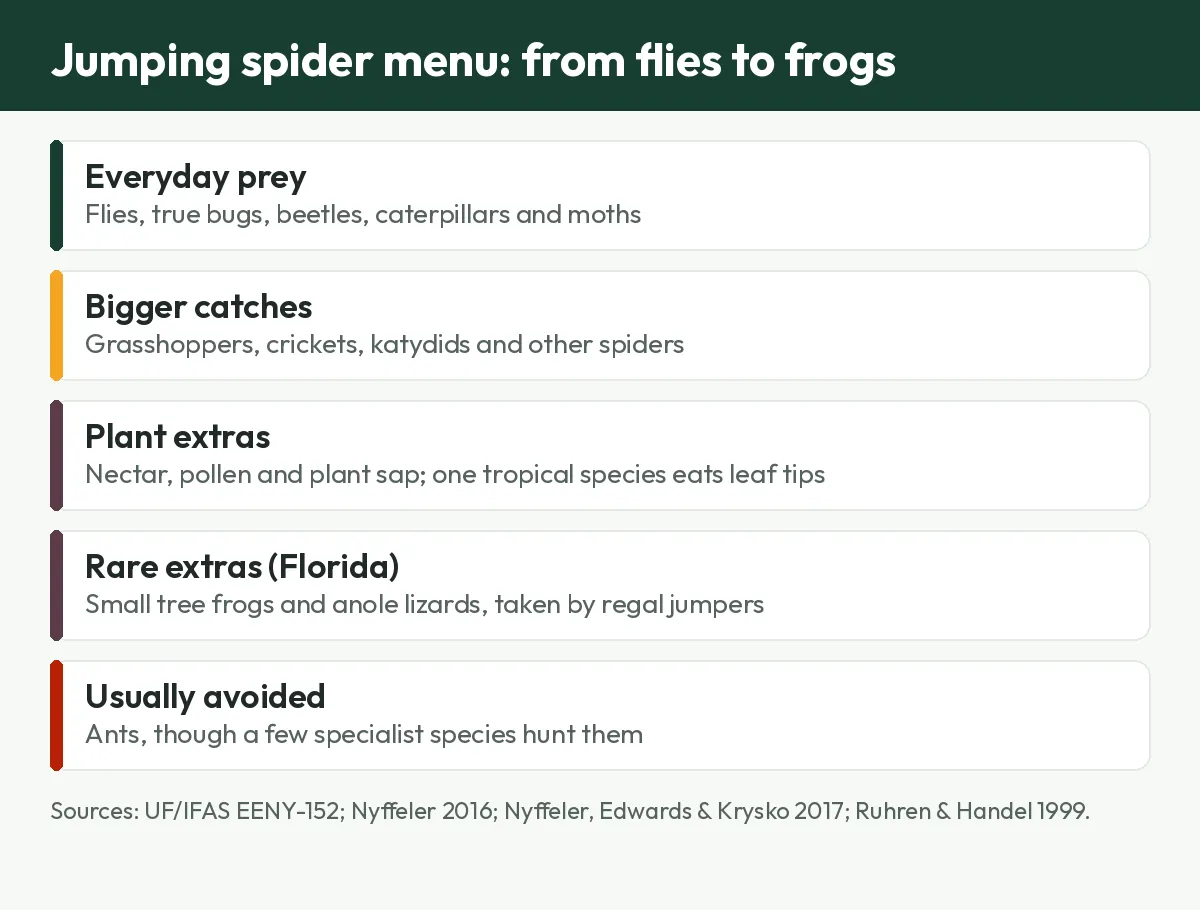
Jumping spiders (family Salticidae) eat mostly small insects and other spiders: flies, true bugs, beetles, caterpillars, moths and young grasshoppers. Many also sip nectar now and then. A few large U.S. species have even been seen eating small frogs and lizards, but that is rare.
What Do Jumping Spiders Eat in the Wild?
Wild jumping spiders eat almost any small arthropod they can see and pounce on. They are daytime generalist hunters, so the menu depends on what lives on the plant, wall or fence they patrol.
A University of Florida prey list covers flies and aphids, beetles and earwigs, crickets and grasshoppers, mites and fellow spiders. Ohio State Extension adds scale insects and cockroaches.
Real field counts are rare, but one U.S. study stands out. In a Mississippi old field next to cotton, researcher Orrey Young recorded 58 meals of the bold jumping spider (Phidippus audax) over two weeks in October 1986.
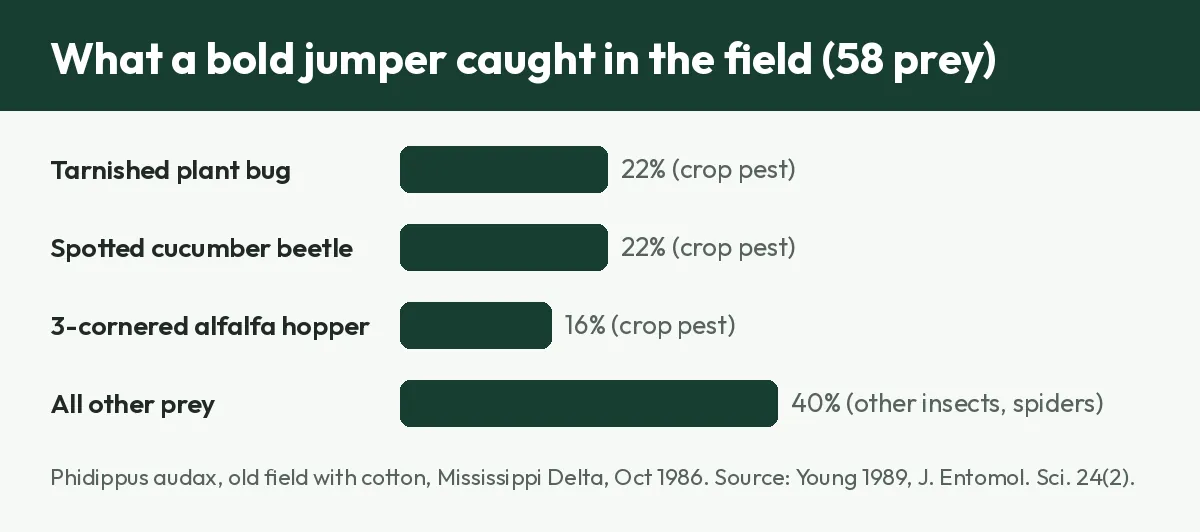
Three crop pests made up 60% of those meals. The commonest insect on the plants, the spotted cucumber beetle, was caught at one of the lowest rates, so these spiders were not simply grabbing whatever was most abundant.
What Bugs Do Jumping Spiders Eat Most Often?
Flies dominate the diet of small jumping spiders, while larger ones switch to grasshoppers, true bugs and moths. UF/IFAS describes this shift for the regal jumping spider (Phidippus regius), the largest common species in the Southeast.
| Spider stage or species | Main prey reported |
|---|---|
| Small young regal jumpers | Flies (Diptera) |
| Older young and adult regal jumpers | Grasshoppers, crickets, true bugs, caterpillars and moths |
| Adult bold jumpers, Mississippi | Plant bugs, cucumber beetles, hoppers, other spiders |
| Jumpers on partridge pea, New Jersey | Plant-eating insects, ants, bees, other spiders, plus nectar |
One regal jumper was even collected while eating an adult Diaprepes root weevil, a serious pest of Florida citrus and sugarcane.
How Big Can Jumping Spider Prey Be?
Jumping spiders often catch prey bigger than themselves, and some species take prey up to three times their own length. Regal jumpers, up to 2.2 cm long, have been seen taking shieldback katydids twice their own length.
- Typical species: most jumping spiders weigh only 0.006–0.2 g, too light to overpower anything with a backbone.
- Regal jumper: adult females weigh about 0.5–1 g, making them heavyweights in the family.
- Frog meals: frogs taken in Florida were about 1–1.5 times the spider’s body length.
- Lizard meals: anoles measured about 1.5–2.5 times the spider’s length, snout to vent.
Venom does the heavy lifting. Once the spider bites, prey much bigger than the hunter can be held and eaten.
Do Jumping Spiders Eat Frogs or Lizards?
Rarely, and so far only the biggest species. A 2017 report documented eight cases in seven Florida counties of regal jumping spiders eating small frogs and anoles.
- Prey included tree frogs (Hyla), Cuban tree frogs, green anoles and brown anoles.
- Both female and male regal jumpers were seen feeding.
- Before this report, vertebrate predation by jumping spiders had not been described in the scientific literature.
- Across all spiders, 27 of 114 families are now known to eat a vertebrate occasionally.
For everyday regal jumpers, insects and spiders remain almost the entire diet. A frog is a lucky extra, not a staple.
Do Jumping Spiders Eat Plants or Nectar?
Yes, many do, and jumping spiders are the leading plant-eaters among spiders. A 2016 review found they account for about 60% of all reported cases of spiders feeding on plant foods.
The best U.S. evidence comes from New Jersey old fields. There, Eris and Metaphidippus jumpers drank nectar from leaf glands of partridge pea while still hunting insects.
- Given a choice in the lab, the spiders spent 86% of their time on plants with working nectar glands.
- Partridge pea plants with resident spiders set significantly more seed than plants without them.
- In South Carolina, Hentzia mitrata and Pelegrina galathea were photographed biting leaves and drinking the sap that oozed out.
- The most northern nectar record for jumping spiders comes from Michigan.
The extreme case lives in Mexico and Costa Rica. Bagheera kiplingi eats protein-rich leaf tips (Beltian bodies) of ant-acacias, which made up 91% of food items in Mexico and 60% in Costa Rica.
That makes it the only spider known to feed mainly and deliberately on plants. It does not live in the U.S.
Do Jumping Spiders Eat Mosquitoes?
Some do, and one East African species specializes in them. Evarcha culicivora prefers female mosquitoes that have just drunk blood, getting a vertebrate blood meal secondhand.
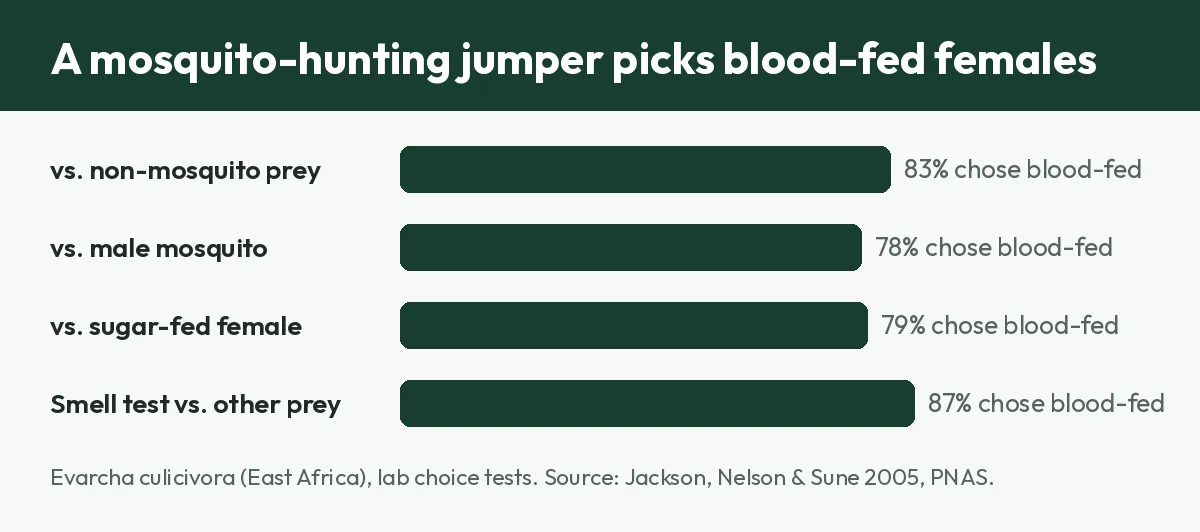
The preference worked by sight alone and by smell alone. Small youngsters normally pick smaller prey, yet they still chose a blood-fed mosquito that was larger than they liked.
This taste is unusual. When 19 other East African jumping spider species were tested in 2012, none chose blood-fed mosquitoes more often than other prey.
Do Jumping Spiders Eat Ants?
Many jumping spiders avoid ants, because ants bite, sting and swarm. They spot ants by sight and usually wait, retreat or outrun them.
At nectar glands, spiders often wait until guarding ants leave before rushing in to drink. A few species, such as Tutelina elegans in the eastern U.S., are ant specialists that do hunt them.
How Do Jumping Spiders Catch Their Food?
Jumping spiders hunt by sight in daylight, stalking prey and then leaping onto it. They do not build capture webs.
- Spot: large forward eyes pick out moving prey from a distance.
- Stalk: the spider creeps closer, often pausing to stay unnoticed.
- Anchor: it attaches a silk safety line before launching.
- Leap: a quick rise in blood pressure extends the legs, since jumping spiders lack big jumping muscles.
- Grab and bite: the front legs seize the prey and venom subdues it.
That same bite is why handling a big jumper can sting. See whether jumping spiders bite people for what actually happens.
What Do Baby Jumping Spiders Eat?
Spiderlings start on tiny soft prey, especially small flies. UF/IFAS reports that young regal jumpers feed heavily on flies before moving up to larger insects.
Plant sugar helps too. A young putnam jumping spider (Phidippus putnami) was photographed drinking at a leaf nectar gland right after leaving its brood sac.
What Should You Feed a Pet Jumping Spider?
Feed a pet jumping spider live, store-bought insects about the size of its abdomen. Exotic Pet Vets recommends fruit flies, green bottle flies, small crickets and mealworms.
| Care point | Vet guidance |
|---|---|
| Juveniles | Two or three meals a week |
| Adults | Often want food only about once a week |
| Prey source | Buy feeders; wild insects may carry pesticides |
| Crickets and mealworms | Watch closely; they can bite the spider |
| Molting | No feeding during a molt or for 2–4 days after |
| Water | Mist the enclosure 1–2 times a week; offer a very shallow dish or bottle cap twice a week |
Research backs the “no wild prey” rule. In one lab study, bold jumpers could not detect toxic plant compounds added to flies, ate them anyway, and many died.
Size the meal to the spider. In choice tests with the mosquito-eating jumper, the smallest juveniles picked smaller prey, while adults and larger juveniles picked larger items.
Are Jumping Spiders Good for Garden Pest Control?
Jumping spiders give real but modest pest control. They eat crop pests, yet each spider catches only a small share of the insects around it.
| Field finding | Number |
|---|---|
| Prey records that were crop pests (Mississippi) | 60% |
| Bold jumpers feeding at any moment | About 7.6% |
| Share of available prey eaten in two weeks | About 3.3% |
| Estimated tarnished plant bug removal | About 10% every 1–2 weeks |
- Help them: Ohio State Extension suggests growing a mix of flowers, giving jumpers nectar and pollen when prey is scarce.
- Bonus: partridge pea plants with jumping spiders produced more seed in New Jersey trials.
- Limit: spiders will not stop a heavy outbreak alone, so combine them with other garden practices.
How Does a Jumping Spider Diet Compare With a Wolf Spider’s?
Both eat mostly insects and other spiders, but they hunt in different places. Jumping spiders stalk prey on plants and walls by day, while wolf spiders ambush ground insects, mostly at night.
Jumpers also sip nectar far more often. Read what wolf spiders eat or what tarantulas eat, and browse more jumping spider guides or other spider types.
Related Guides
- All jumping spider articles
- SpiderNexa home: common spiders in the U.S.
- Do Wolf Spiders Make Webs? What They Build Instead
- Are Orb Weaver Spiders Poisonous? What a Bite Really Does
- How to Identify a Brown Recluse Spider: The 5-Point Check
- How Long Do Spiders Live? Lifespans by Spider Type
- Can Jumping Spiders Bite? What Happens and How Rare It Is
- Are Huntsman Spiders Poisonous? Bite Facts for U.S. Homes
- What Do Tarantulas Eat? Wild U.S. Diet, Rare Prey and Pet Care
- Six-Spotted Fishing Spider: How Dolomedes triton Hunts on Water
- What Do Wolf Spiders Eat? Prey, Hunting and Pest Control
- Spider types: six common groups compared
- How to identify a spider in five steps
- Spider facts with sources
- All SpiderNexa articles
Frequently Asked Questions
Do jumping spiders eat other spiders?
Yes. UF/IFAS lists other spiders among typical prey, and regal jumpers feed almost entirely on insects and spiders. Bold jumpers in Mississippi also caught other spiders on cotton plants.
Do jumping spiders eat cockroaches?
Yes, when they can catch them. Ohio State Extension names cockroaches among the larger insects jumping spiders feed on. Small roaches are far easier for them than big adults.
Do jumping spiders eat fruit?
There is no good evidence that jumping spiders eat fruit. The plant foods recorded for them are nectar, pollen, plant sap, honeydew and, in one tropical species, acacia leaf tips.
Do jumping spiders drink water?
Yes, they drink droplets, and pet care vets advise misting the enclosure and offering a tiny shallow dish. In lab tests, jumping spiders also preferred sugar water over plain water.
What does the regal jumping spider eat?
Young regal jumpers eat mostly flies. Older ones take grasshoppers, true bugs, caterpillars and moths, and in rare Florida cases small frogs and anoles.
References
- Young (1989), Field observations of predation by Phidippus audax on arthropods associated with cotton – Journal of Entomological Science 24(2)
- Edwards, Regal Jumping Spider, Phidippus regius – UF/IFAS Featured Creatures EENY-152
- Nyffeler, Edwards & Krysko (2017), A vertebrate-eating jumping spider from Florida, USA – Journal of Arachnology 45(2)
- Nyffeler (2016), Phytophagy in jumping spiders: the vegetarian side of a group of insectivorous predators – Peckhamia 137.1
- Ruhren & Handel (1999), Jumping spiders enhance the seed production of a plant with extrafloral nectaries – Oecologia 119
- Meehan et al. (2009), Herbivory in a spider through exploitation of an ant–plant mutualism – Current Biology 19
- Jackson, Nelson & Sune (2005), A spider that feeds indirectly on vertebrate blood by choosing female mosquitoes as prey – PNAS 102(42)
- Jackson & Nelson (2012), Evarcha culicivora chooses blood-fed Anopheles mosquitoes but other East African jumping spiders do not – Medical and Veterinary Entomology 26
- Ohio’s Natural Enemies: Jumping Spiders – Ohio State University Extension, Ohioline ENT-74
- Jumping Spiders – UF/IFAS Beneficial Arthropods: Predators
- Jumping Spider Care Guide – Exotic Pet Vets