What Do Wolf Spiders Eat? Prey, Hunting and Pest Control
Quick Answer
Wolf spiders (family Lycosidae) mostly eat ground-dwelling insects: grasshoppers, crickets, beetles, moths, true bugs and young cockroaches. Other spiders are a regular part of the menu too. Big species sometimes catch a small frog or lizard, but prey larger than the spider itself is usually ignored.
What Do Wild Wolf Spiders Eat?
Out in fields and yards, they eat whatever soft-bodied insects they can overpower on the ground. Field counts from two U.S. species show grasshoppers, crickets and beetles at the top of the list.
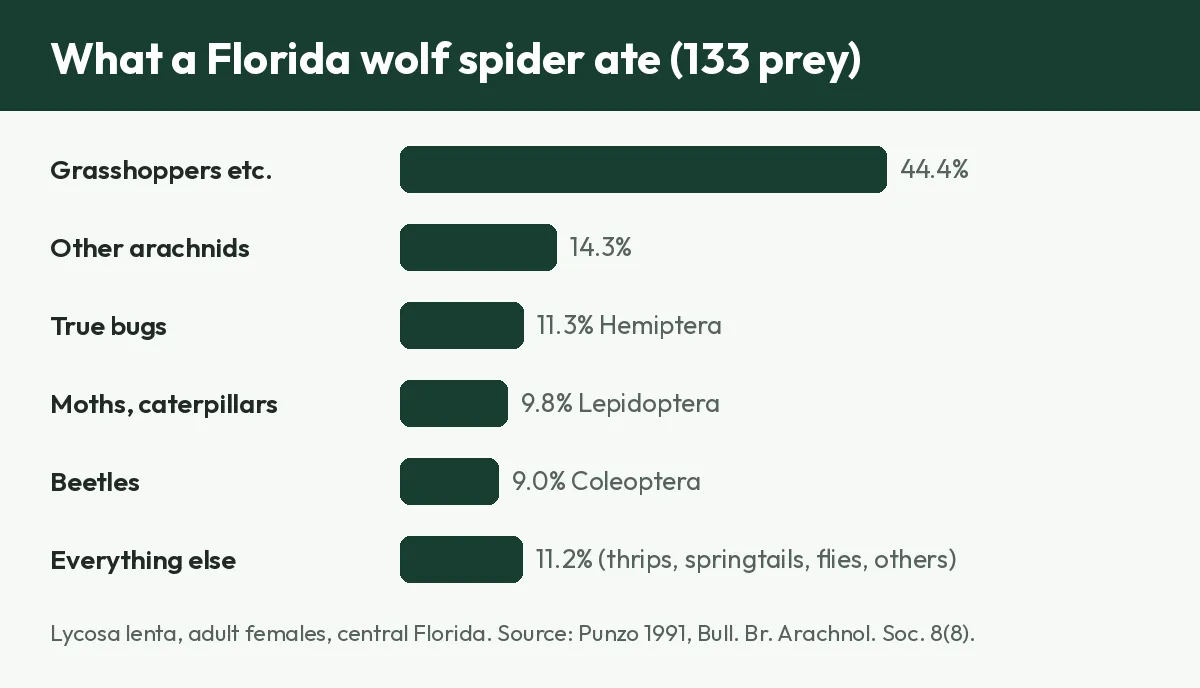
In central Florida, researcher Fred Punzo collected 133 prey items straight from the jaws of Lycosa lenta. Insects made up 85.7% of the haul and other arachnids the remaining 14.3%.
A second study at Big Bend National Park, Texas, checked 416 Carolina wolf spiders (Hogna carolinensis), a large species found across the U.S. Only 58 of them (about 14%) were holding prey when found.
| Prey group | Males | Females |
|---|---|---|
| Beetles (mostly ground beetles) | 25.0% | 22.7% |
| Grasshoppers and crickets | 13.8% | 27.2% |
| Sand cockroaches | 5.5% | 9.1% |
| Other spiders | 13.5% | 0% |
Diet shifts with body size. Small wolf spiders such as Pardosa live mainly on springtails, small flies and aphids, while the big Hogna and Lycosa species take grasshoppers and beetles.
How Big Can Wolf Spider Prey Be?
Most wolf spiders take prey smaller than their own body. In lab trials with Florida wolf spiders about 17–18 mm long, acceptance fell sharply once prey grew larger than the spider.
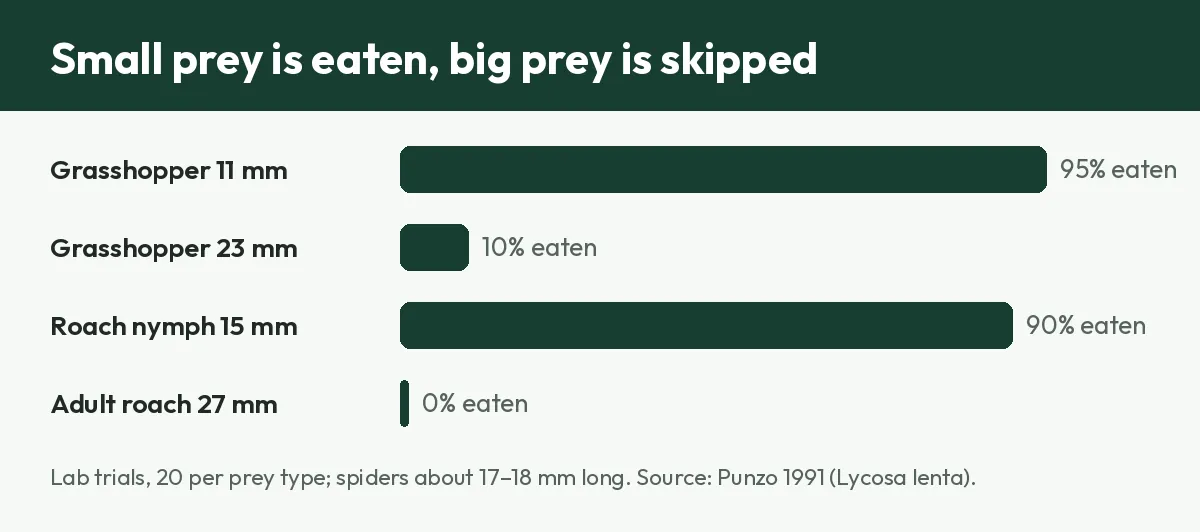
- Grasshoppers about 11 mm long were eaten 95% of the time; those about 23 mm long, only 10%.
- American cockroach nymphs (about 15 mm) were eaten 90% of the time; adults (about 27 mm) were never eaten.
- The study notes that hunting spiders generally catch prey about 50–80% of their own length.
So a wolf spider hiding in a garage will happily take a small roach or cricket. A full-grown American cockroach is usually more than it wants to handle.
What Prey Do Wolf Spiders Refuse?
Wolf spiders tend to refuse hard-shelled or chemically defended insects. The same Florida trials showed clear rejections even when the spiders were hungry.
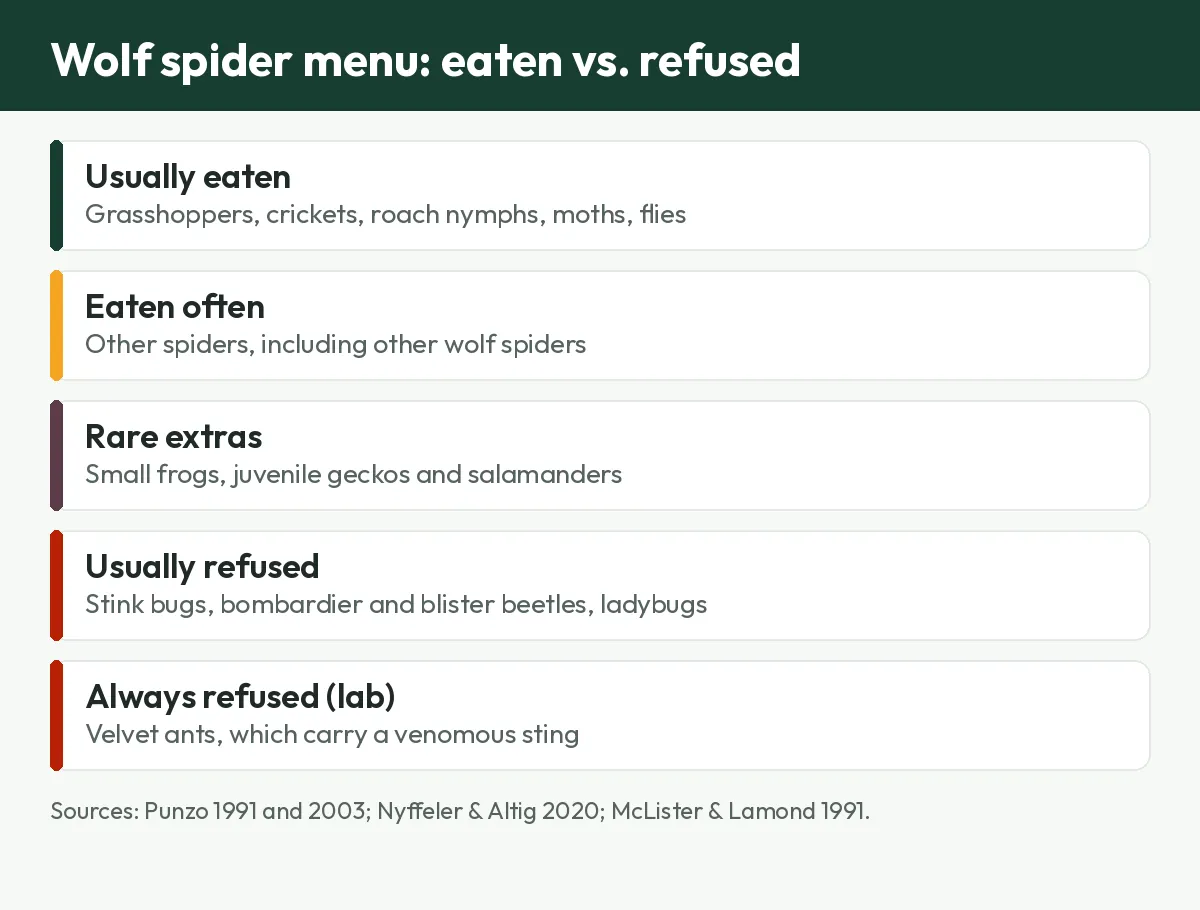
- Chemical sprayers: bombardier beetles, blister beetles and stink bugs.
- Warning-colored beetles: convergent lady beetles were largely rejected.
- Stinging prey: velvet ants (actually wingless wasps) were never taken.
- Armored prey: tough ground beetles had low acceptance in the lab, though Hogna eats many of them in the wild.
Fireflies, on the other hand, were caught and eaten both in the field and in the lab.
Do Wolf Spiders Eat Cockroaches?
Yes, they do, especially young roaches. American cockroaches made up 13.5% of prey in the Florida study, and Clemson Extension lists cockroaches among common wolf spider prey.
Size still matters. Nymphs are easy targets, while adult American cockroaches were refused in every lab trial, even though a few adults showed up in the field diet.
Seeing a wolf spider indoors usually means it wandered in or followed insects. If you are unsure of the spider, our spider identification guide walks through the eye pattern.
How Do Wolf Spiders Hunt Their Prey?
Wolf spiders hunt mainly by sitting still and ambushing prey, then making a short, fast rush. They do not use a capture web; see what wolf spiders build instead.
- Wait: burrow owners in Texas sat in or within 2–8 cm of the entrance.
- Sense: they turn toward ground vibrations and use large forward eyes at night.
- Strike: prey that came within about 1.5 cm of a burrow was seized and pulled inside.
- Chew: wolf spiders crush prey with their jaws into a small “meat ball,” which helps them extract every bit of food.
After a catch away from the burrow, Carolina wolf spiders fed for 3–24 minutes before heading home.
Do Wolf Spiders Eat Frogs, Lizards or Other Vertebrates?
Occasionally, yes. Large wolf spiders catch small frogs and, more rarely, lizards or salamanders, but vertebrates are a rare extra, not a staple.
- A 2020 global review counted 374 cases of spiders eating frogs; 85% involved web-less hunters, and wolf spiders were one of four groups named as frequent frog hunters.
- U.S. species on that list include the Carolina wolf spider and Tigrosa helluo (formerly Hogna helluo).
- Tigrosa helluo was found eating a juvenile blue-spotted salamander in Ontario in 1990.
- Punzo saw adult female Carolina wolf spiders feeding on juvenile Texas banded geckos at Big Bend.
None of the 58 prey items recorded in the Big Bend diet study was a vertebrate. That shows how uncommon these meals are.
What Do Baby Wolf Spiders Eat?
Newly hatched spiderlings eat nothing at first; they live on leftover egg yolk while riding on their mother’s back. They start hunting tiny prey only after they climb down.
- The spiderlings ride for about a week, until their next molt.
- In Pardosa saltans, the first meal came 7–8 days after leaving the egg sac, with 70% of the yolk energy already used.
- Their first prey are very small animals, caught once the young spread out away from the mother.
- Some spiderlings eat each other; about 10% of day-8 juveniles in the lab study were cannibals.
Mothers keep hunting while carrying eggs or young, but they feed less often than other females, according to a two-year Swiss field study.
Are Wolf Spiders Good for Pest Control?
Wolf spiders help with pest control, but modestly. They eat real pests, yet field studies show they eat far less often than many people assume.
| Field finding | Number |
|---|---|
| Wolf spiders seen holding prey, Swiss wheat fields | About 4% of ~2,500 |
| Estimated prey per day, adult female Pardosa agrestis | A little more than 1 |
| Spiders feeding at any moment, Swiss hay meadow | 4.9% of 710 |
| Share of diet that was flies, springtails and aphids (wheat) | About 80% |
- The good: they ate harmful cereal aphids in wheat, and Missouri Conservation notes they eat many insect pests.
- The limit: roughly one small meal a day will not wipe out an infestation.
- Best use: leave wolf spiders in gardens and lawns, and fix indoor pest problems at the source.
For a wider look at how long these predators stay on the job, see how long spiders live.
How Does a Wolf Spider Diet Compare With a Tarantula’s?
Both are ground hunters that eat mostly insects, but they find food differently. Wolf spiders rely on sight and quick rushes, while tarantulas mostly feel prey through silk and body hairs.
Tarantulas also go weeks between meals. Read what tarantulas eat for their U.S. desert diet, or browse more wolf spider guides and other spider types.
Jumping spiders, by contrast, stalk prey on plants by day and often sip nectar. Compare what jumping spiders eat.
Related Guides
- What Do Jumping Spiders Eat? Wild Prey, Nectar and Pets
- All wolf spider articles
- SpiderNexa home: common spiders in the U.S.
- Do Wolf Spiders Make Webs? What They Build Instead
- Are Orb Weaver Spiders Poisonous? What a Bite Really Does
- How to Identify a Brown Recluse Spider: The 5-Point Check
- How Long Do Spiders Live? Lifespans by Spider Type
- Can Jumping Spiders Bite? What Happens and How Rare It Is
- Are Huntsman Spiders Poisonous? Bite Facts for U.S. Homes
- What Do Tarantulas Eat? Wild U.S. Diet, Rare Prey and Pet Care
- Six-Spotted Fishing Spider: How Dolomedes triton Hunts on Water
- Spider types: six common groups compared
- How to identify a spider in five steps
- Spider facts with sources
- All SpiderNexa articles
Frequently Asked Questions
Which prey do wolf spiders take most often?
Grasshoppers, crickets and beetles top the list in U.S. field studies. In Florida, grasshoppers and their relatives made up 44% of prey; in Texas, beetles and grasshoppers made up about half.
Do wolf spiders eat other spiders?
They do, and often. Arachnids were 14.3% of prey for a Florida wolf spider, including other wolf spiders at 9.1%. Spiders were also 13.5% of prey for male Carolina wolf spiders in Texas.
Do wolf spiders eat ants?
Rarely. Ants were only a minor item in the Florida diet study. In Texas, a column of Pheidole ants once poured into a Carolina wolf spider burrow, and the spider was gone by morning.
How long can a wolf spider go without eating?
Wolf spiders can go a long time between meals because they eat infrequently even in good conditions. Swiss field studies on Pardosa found fewer than 5% feeding at any moment. Exact fasting limits vary by species and were not measured in the sources we used.
What should I feed a pet wolf spider?
Offer live insects smaller than the spider, such as small crickets or roach nymphs, and a little moisture. Skip stink bugs, ladybugs and other defended insects, which wolf spiders tend to reject.
References
- Punzo (1991), Field and laboratory observations on prey items taken by the wolf spider Lycosa lenta – Bulletin of the British Arachnological Society 8(8)
- Punzo (2003), Natural history and ecology of Hogna carolinensis in the northern Chihuahuan Desert – Bulletin of the British Arachnological Society 12(9)
- Nyffeler & Benz (1988), Feeding ecology of wolf spiders (Pardosa) in winter wheat fields – Journal of Applied Entomology
- Nyffeler & Breene (1990), Low daily food consumption by wolf spiders in meadowland – Journal of Applied Entomology
- Nyffeler (2000), Do adult female lycosids feed during the period of maternal care? – Bulletin of the British Arachnological Society 11(9)
- Laino et al. (2020), Residual vitellus and energetic state of wolf spiderlings Pardosa saltans – Journal of Comparative Physiology B
- Nyffeler & Altig (2020), Spiders as frog-eaters: a global perspective – Journal of Arachnology 48
- McLister & Lamond (1991), A wolf spider, Hogna helluo, feeding on a blue-spotted salamander – Canadian Field-Naturalist 105(4)
- Wolf Spiders – Clemson Cooperative Extension, Home & Garden Information Center
- Wolf Spiders – Missouri Department of Conservation