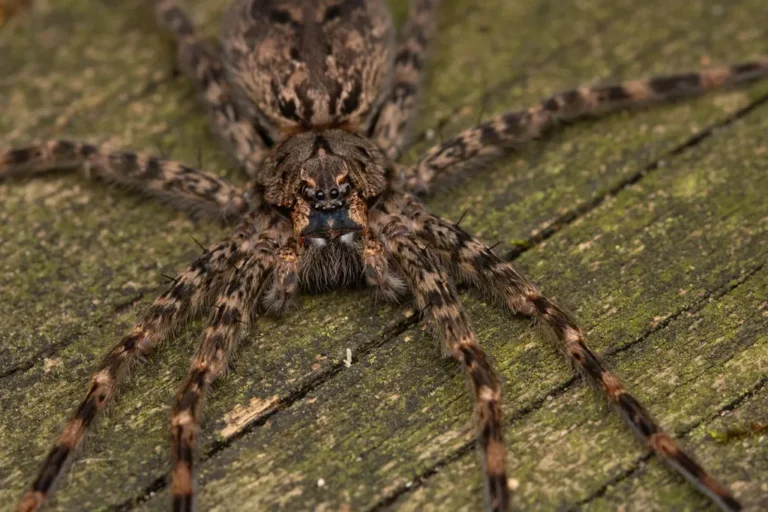
Six-Spotted Fishing Spider: How Dolomedes triton Hunts on Water
Quick Answer
The six-spotted fishing spider (Dolomedes triton) is a North American spider that lives on ponds and slow streams. It runs across the water surface, senses ripples from prey, and can dive and stay under water for up to 45 minutes.
How Do You Identify a Six-Spotted Fishing Spider?
Look for a dark brown spider with a pale stripe along each side and rows of white dots on the abdomen, sitting at the water’s edge. Females have a body about ¾ inch long; males are about ½ inch.
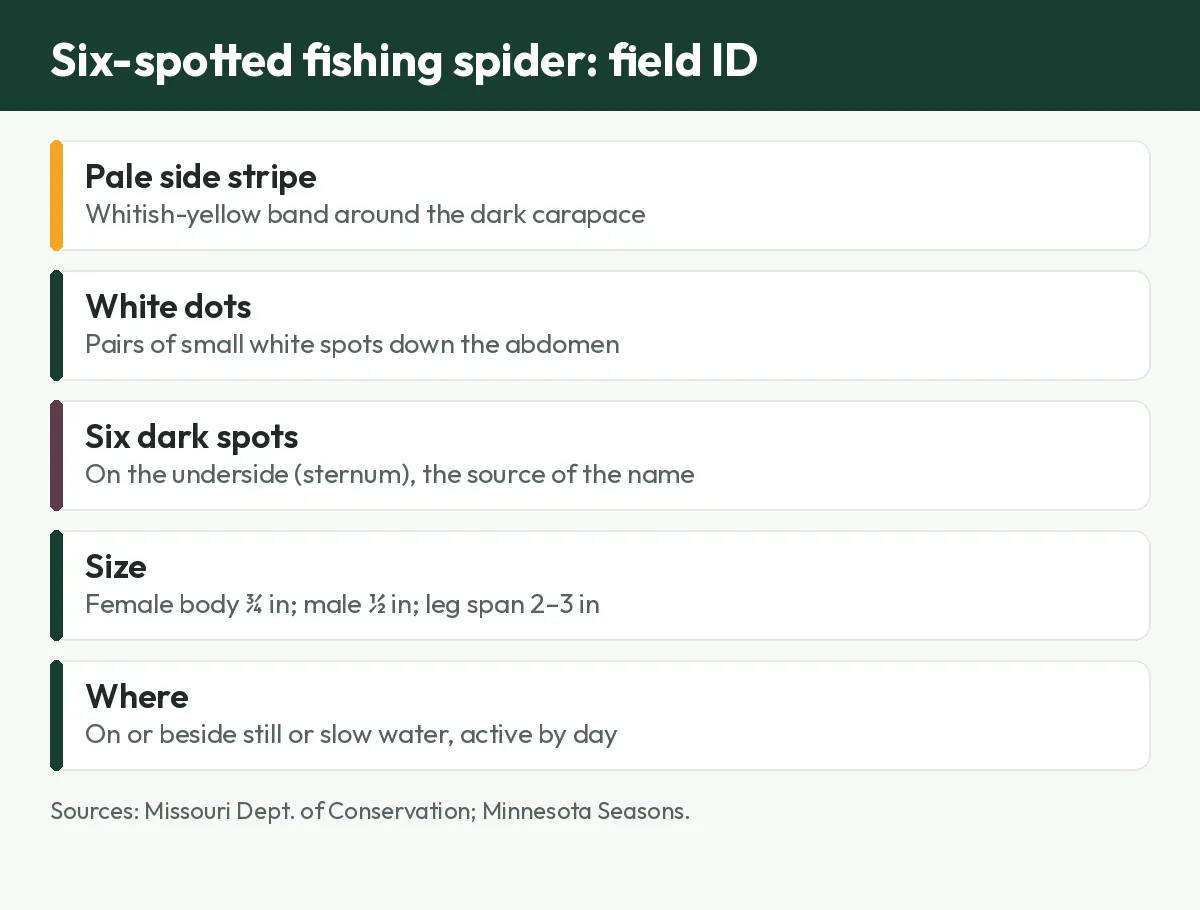
The “six spots” are not on top. The Missouri Department of Conservation explains that the name comes from six dark spots on the underside, which you rarely see.
Where Does the Six-Spotted Fishing Spider Live?
It lives across much of the eastern and central U.S., from New England to Florida and west to North Dakota and Texas. It needs ponds, lakes, swamps or slow streams with floating plants.
Minnesota naturalists rank it among the biggest spiders in that state. It is active in daylight, which makes it easier to watch than most fishing spiders.
How Does It Walk on Water and Dive?
Water-repellent hairs let it stand on the surface film like a water strider. To submerge, it traps a layer of air around its body and breathes from it.
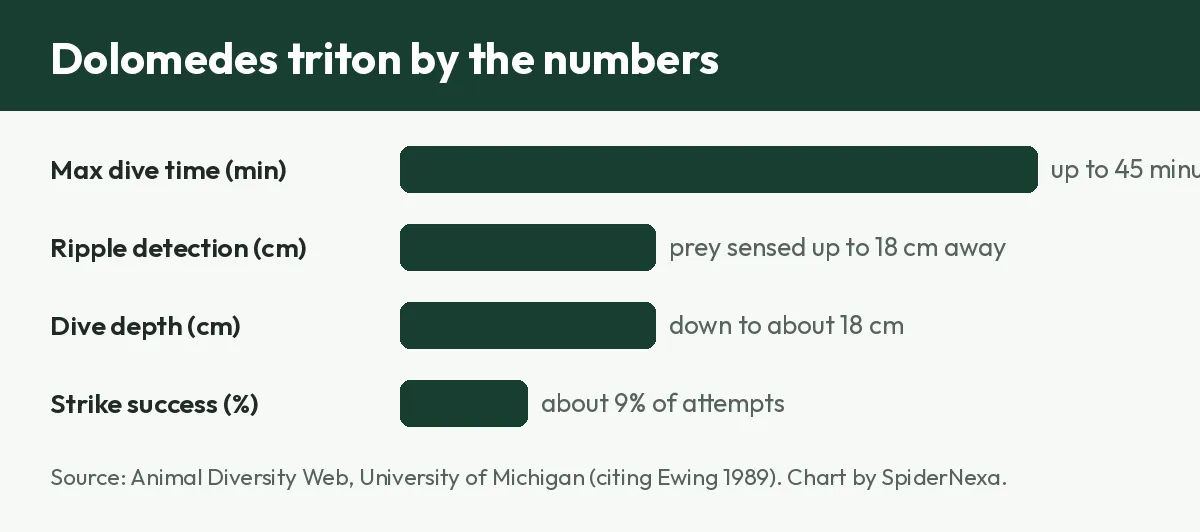
- Dive time: up to 45 minutes, per Animal Diversity Web.
- Why it dives: to chase prey or to escape birds and fish.
- Depth: about 18 cm (7 in) below the surface.
What Prey Does Dolomedes triton Catch?
Mostly aquatic insects, plus tadpoles and very small fish. Mississippi State University Extension calls it the “real fisherman” of its genus because adults specialize more in minnows and tadpoles.
Missouri even recorded one eating an adult Blanchard’s cricket frog. Young spiders stick to small insects.
How Successful Is a Fishing Spider Strike?
Not very. Animal Diversity Web reports that strikes on ripple signals succeed only about 9% of the time.
The spider struggles to tell prey ripples from ripples caused by dropping twigs or leaves. Prey that bumps into it directly is caught more often, about 16% of the time.
How Is It Different From the Dark Fishing Spider?
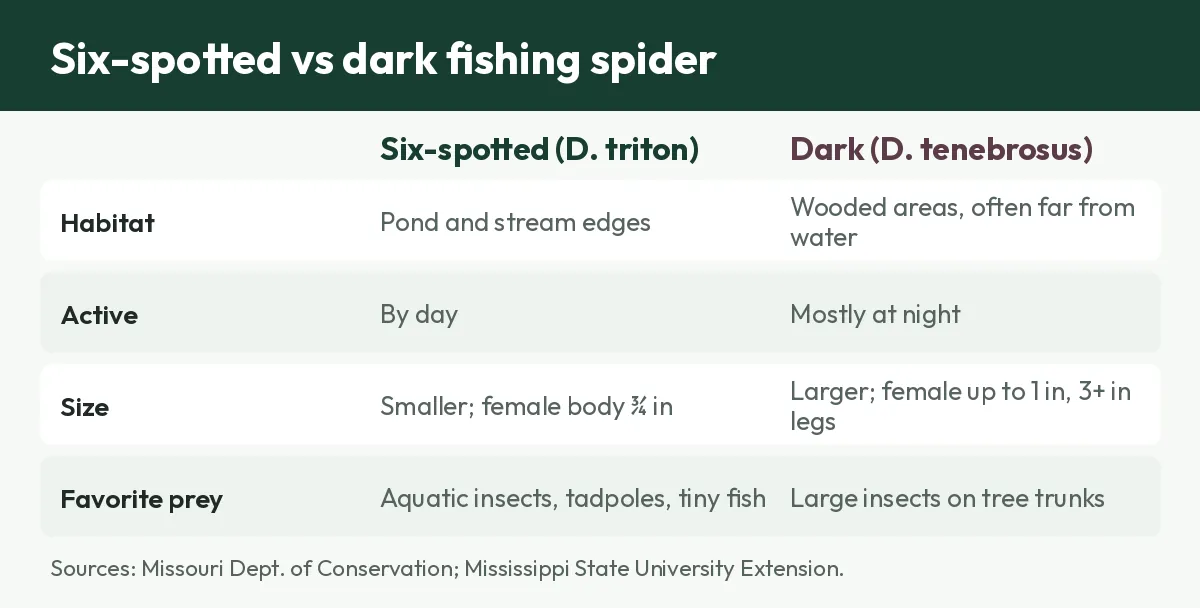
The six-spotted fishing spider stays near water and hunts by day. The dark fishing spider is larger, hunts at night and often lives on tree trunks far from water.
For more on the whole group, see our fishing spider guide.
What Hunts the Six-Spotted Fishing Spider?
Anglers know it as food for trout, bass, catfish and sunfish. Its most specialized enemy is Anoplius depressipes, a dark spider wasp with a blue sheen.
The wasp’s fringed front feet let it skim across water; it paralyzes the spider and tows it across the surface back to its nest.
Is the Six-Spotted Fishing Spider Dangerous?
No. Fishing spiders can give a painful bite if handled, but Mississippi State University Extension says the bite is not medically serious and that bites are rare.
It also eats mosquito larvae and other aquatic insects. Leaving it alone at a pond or dock is the best choice.
Related Guides
- Do Wolf Spiders Make Webs? What They Build Instead
- Are Orb Weaver Spiders Poisonous? What a Bite Really Does
- How to Identify a Brown Recluse Spider: The 5-Point Check
- How Long Do Spiders Live? Lifespans by Spider Type
- Can Jumping Spiders Bite? What Happens and How Rare It Is
- Are Huntsman Spiders Poisonous? Bite Facts for U.S. Homes
- What Do Tarantulas Eat? Wild U.S. Diet, Rare Prey and Pet Care
- Spider types: six common groups compared
- How to identify a spider in five steps
- Spider facts with sources
- All SpiderNexa articles
Six-Spotted Fishing Spider FAQ
How big does a six-spotted fishing spider get?
Females have a body about ¾ inch long and males about ½ inch. Including legs, they span roughly 2 to 3 inches.
Can a six-spotted fishing spider breathe underwater?
It breathes from a thin layer of air trapped by its body hairs. This lets it stay submerged for up to about 45 minutes.
Is it active during the day or night?
It is active by day. That sets it apart from the dark fishing spider, which mostly hunts at night.
Why is it called six-spotted?
The name refers to six dark spots on its underside (the sternum), not to the white dots on its back.
References
- Spotted Fishing Spider – Missouri Department of Conservation
- Dolomedes triton – Animal Diversity Web, University of Michigan
- Six-spotted Fishing Spider – Minnesota Seasons
- Dark Fishing Spider – Mississippi State University Extension
- The Everyday Naturalist: Fishing Spiders – Smithsonian Environmental Research Center