Are Huntsman Spiders Poisonous? Bite Facts for U.S. Homes
Quick Answer
No. Huntsman spiders are venomous, not poisonous, and they are not dangerous to people. A bite is uncommon and usually happens only when the spider is handled or trapped; it can be locally painful and sometimes swollen, but it fades without serious effects.
Is a Huntsman Spider Bite Dangerous?
No. University of Florida experts describe the pantropical huntsman (Heteropoda venatoria) as not dangerous. A bite can hurt and may swell a little.
Bites happen when someone grabs the spider or traps it, for example by putting on a shoe it is hiding in.
Tarantulas share the same “venomous, not poisonous” label. See whether tarantulas are poisonous for why their hairs worry eye doctors more than their bites.
What Do Bite Studies Show?
Most medical data on huntsman bites come from Australia, where these spiders are common in homes. The findings are reassuring.
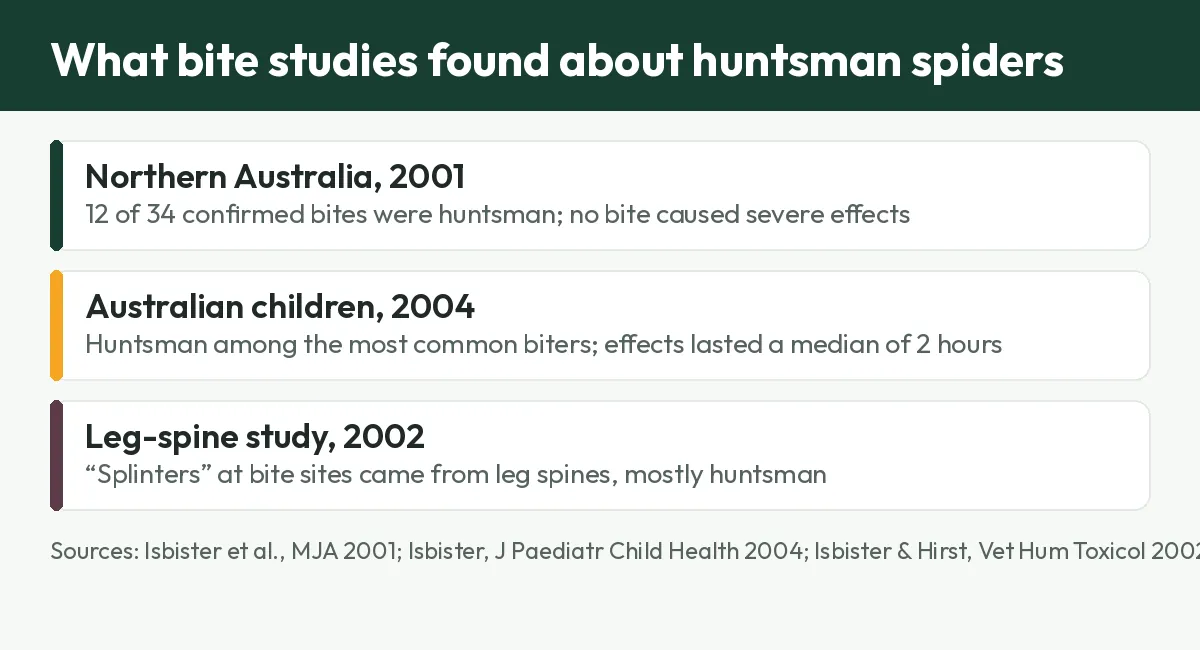
- In northern Australia, 12 of 34 confirmed spider bites were from huntsman spiders, and none caused severe effects.
- In 163 confirmed bites in children, huntsman and orb-weaver bites were the most common, and symptoms lasted a median of 2 hours.
- No bite in the children’s study caused a skin ulcer or infection.
Why Do Some Bites Leave “Splinters”?
Those splinters are leg spines, not fangs. A 2002 study of 15 cases found the “splinters” seen at some bite sites came from spider leg spines, mostly from huntsman spiders.
In one case, a man grabbed a biting huntsman and got spines in his fingers, with redness and itching that lasted over a week. Using a cup and card, not your hand, avoids both problems.
Can You Be Allergic to a Huntsman Spider?
It is possible but very rare. One published case describes a man who developed a body-wide rash after a spider he identified as a huntsman crawled on his arms.
Seek care right away for hives that spread, swelling of the face or throat, dizziness or trouble breathing.
How Big Is a Huntsman Spider?
A pantropical huntsman has a body about 1 inch long and a leg span of 3–5 inches. Its size and sideways speed are what frighten people.
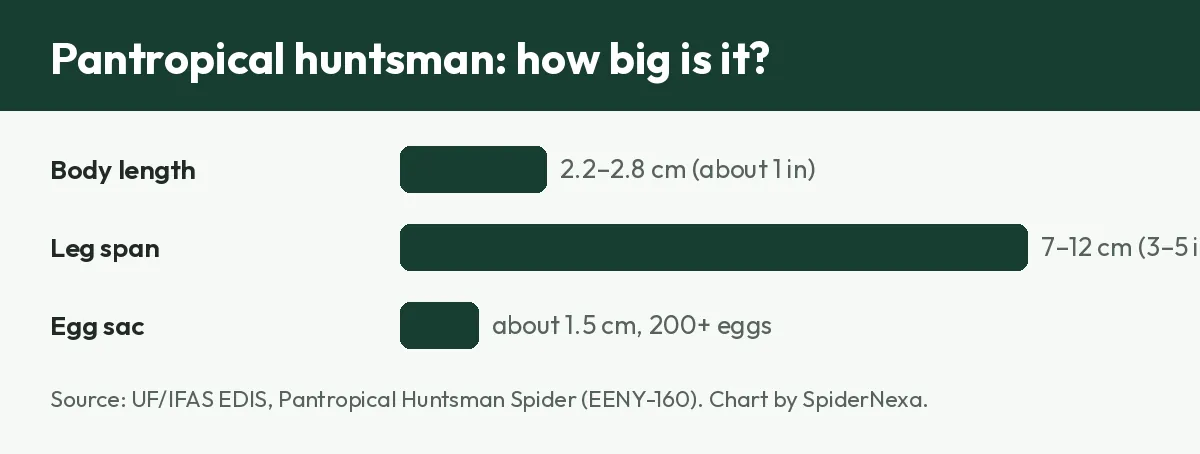
Look for a flat, light-brown body and long legs held out to the sides like a crab. Females carry a round egg sac under the body.
Where Do Huntsman Spiders Live in the U.S.?
In the U.S., the pantropical huntsman lives in warm areas: subtropical Florida, Texas and California, plus coastal Georgia and South Carolina.
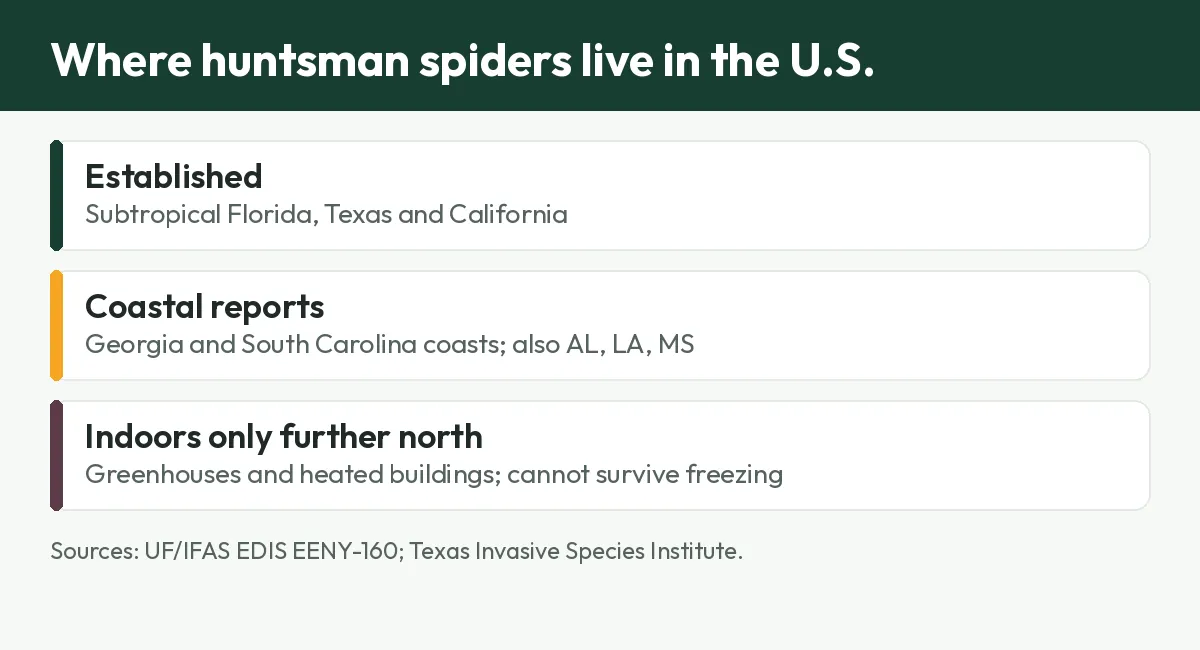
It cannot survive outdoors where winters freeze. Further north, it turns up only in greenhouses and heated buildings, often after arriving in produce shipments.
For verified records by state, Hawaii and the native desert huntsman, see where huntsman spiders live in the U.S.
Is It a Huntsman or a Brown Recluse?
The huntsman is often mistaken for a large brown recluse, but they are not related. The size alone usually settles it.
| Feature | Huntsman | Brown recluse |
|---|---|---|
| Body length | About 1 inch | Up to 3/8 inch |
| Leg span | 3–5 inches | About the size of a quarter |
| Eyes | 8 | 6, in pairs |
| Leg color | Often darker than the body | Plain, same color as the body |
Our brown recluse identification guide explains the five checks in detail.
What Should You Do if One Is in Your House?
- Leave it if you can: it hunts cockroaches and other pests.
- To remove it, cover it with a wide container and slide a card underneath.
- Do not swat a female carrying an egg sac; it can release many spiderlings.
- Shake out shoes and stored clothes in areas where huntsmen are common.
Related Guides
- Are Tarantulas Poisonous? Bites, Venom and Urticating Hairs
- Where Do Huntsman Spiders Live in the U.S.? State-by-State
- Do Wolf Spiders Make Webs? What They Build Instead
- Are Orb Weaver Spiders Poisonous? What a Bite Really Does
- How to Identify a Brown Recluse Spider: The 5-Point Check
- How Long Do Spiders Live? Lifespans by Spider Type
- Can Jumping Spiders Bite? What Happens and How Rare It Is
- What Do Tarantulas Eat? Wild U.S. Diet, Rare Prey and Pet Care
- Six-Spotted Fishing Spider: How Dolomedes triton Hunts on Water
- Spider types: six common groups compared
- How to identify a spider in five steps
- Spider facts with sources
- All SpiderNexa articles
Huntsman Spider FAQ
Do huntsman spiders bite people?
Rarely. They run away rather than bite. Bites happen when the spider is handled roughly or trapped against skin.
What does a huntsman spider bite feel like?
It is usually a sharp, local pain, sometimes with swelling. In Australian studies, effects were mild and often lasted only a few hours.
Are huntsman spiders good to have around?
Many people think so. UF/IFAS notes they are valued in tropical countries for catching cockroaches and other household pests.
Can huntsman spiders live in cold states?
Not outdoors. They are cold-sensitive and cannot survive freezing winters, so northern sightings are usually in heated buildings or produce shipments.
References
- Pantropical Huntsman Spider, Heteropoda venatoria (EENY-160) – UF/IFAS EDIS
- Huntsman Spider – Texas Invasive Species Institute
- Isbister et al. (2001), Clinical effects of bites from formally identified spiders in tropical Northern Territory – MJA
- Isbister (2004), Prospective cohort study of definite spider bites in Australian children – J Paediatr Child Health
- Isbister & Hirst (2002), Injuries from spider spines, not spider bites – Vet Hum Toxicol
- Isbister (2002), Acute allergic reaction following contact with a spider – Toxicon