Do Wolf Spiders Make Webs? What They Build Instead

Quick Answer
No. Wolf spiders (family Lycosidae) do not build webs to catch prey. They hunt on foot, mostly at night, and use silk for safety lines, burrows and egg sacs. The one notable exception in the U.S. is the funnel-web wolf spider (Sosippus) of Florida and nearby states, which builds a funnel-shaped sheet web.
Why Don’t Wolf Spiders Build Webs?
Wolf spiders don’t need a web because they find prey with their eyes and their sense of touch. Two large forward-facing eyes and fast legs let them chase or ambush insects on the ground.
A web works best for spiders that wait in one place. Wolf spiders roam, so a fixed trap would be wasted silk. For the prey they catch instead, see what wolf spiders eat.
If you want to learn the eye layout, see the eye pattern step in our spider identification guide.
How Wolf Spiders Use Silk Instead
All spiders make silk, and wolf spiders use it in at least five ways. None of them involve trapping prey.
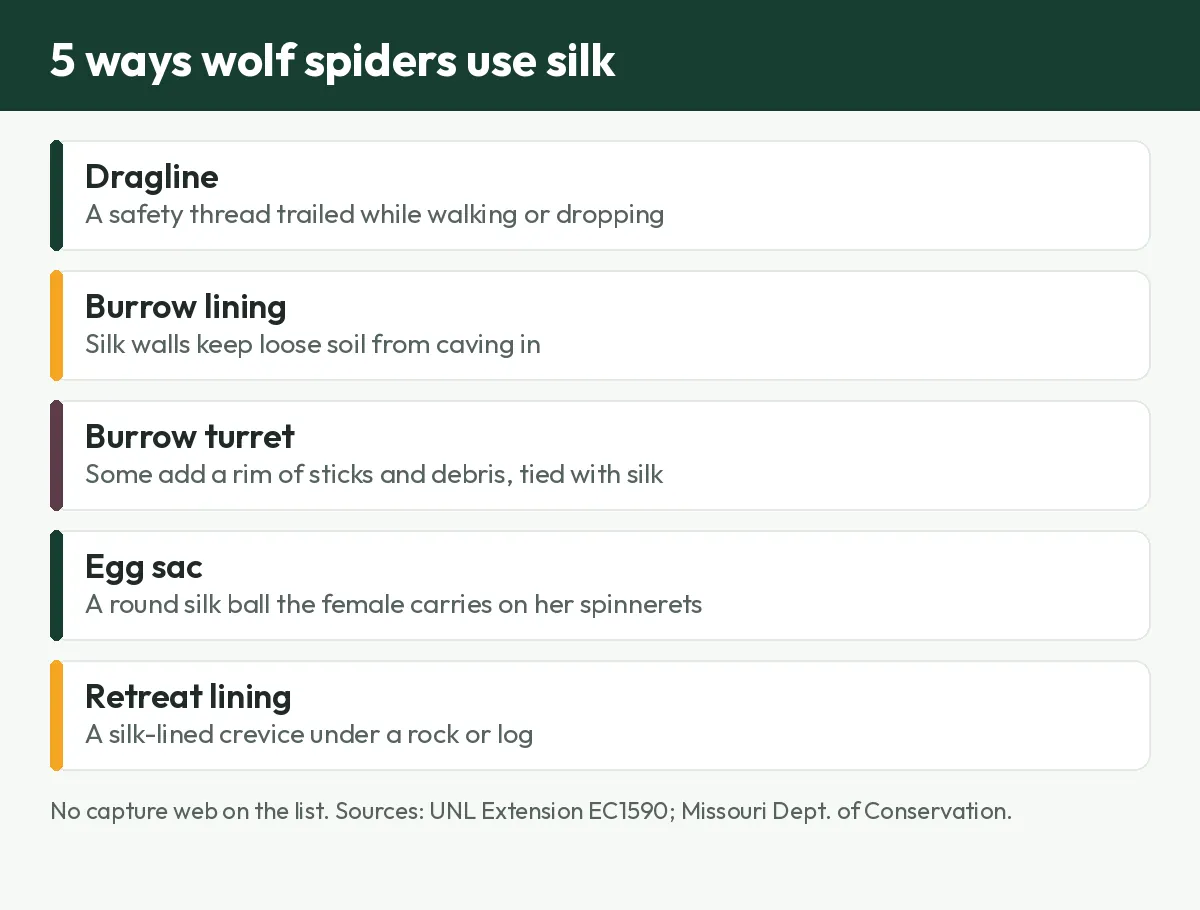
- Dragline: a thin safety thread they trail as they move.
- Burrow lining: silk holds loose soil in place inside the tunnel.
- Turret: some species build a raised rim of sticks and plant bits around the burrow entrance.
- Egg sac: a round silk ball the female attaches to her spinnerets and carries.
- Retreat: a silk-lined hiding spot under a stone, log or board.
Once the spiderlings hatch, they climb onto the mother’s back and ride there for a short time. That is behavior, not silk, but it is often what people notice first.
The Wolf Spider That Does Build a Web
The funnel-web wolf spider, Sosippus floridanus, breaks the rule. It is a true wolf spider that builds a funnel-shaped sheet web, much like a grass spider’s.
A 2006 field study at Hopkins Prairie in Florida described each web as a tube-like retreat that opens into a funnel. Silk lines spread 12–40 cm (about 5–16 inches) from the funnel.
- 8 of the 20 webs studied were on the ground; the rest were in low plants.
- The female shares the web with her young after they hatch.
- Earlier work cited in the same paper reports young staying on the mother’s web for up to 5 months.
This matters for identification. A funnel web in Florida scrub may belong to a wolf spider, while a funnel web in a northern lawn almost always belongs to a grass spider.
Is That Funnel Web From a Wolf Spider or a Grass Spider?
In most of the U.S., a funnel web on the lawn or in shrubs belongs to a grass spider (family Agelenidae). Grass spiders look similar to small wolf spiders, which causes the mix-up.

| Clue | Wolf spider | Grass spider |
|---|---|---|
| Web | None (except Sosippus) | Flat sheet leading into a tube |
| Where it waits | On the ground or in a burrow | At the mouth of the funnel |
| Eyes | 4 small, 2 large, 2 medium (4-2-2) | 8 similar eyes in two rows |
| Spinnerets | Short, hard to see | Long, visible at the tip of the abdomen |
The eye pattern settles it. A close phone photo of the face is usually enough to see two big forward-facing eyes on a wolf spider.
What Does a Wolf Spider Burrow Look Like?
A wolf spider burrow is a round hole in soil, often lined with silk just inside the entrance. Some burrows have a small turret of twigs and debris around the top.
Look for them in bare or sandy ground, lawns with thin grass, and field edges. At night, a flashlight may catch the spider waiting at the entrance.
Which Spider Made the Web You Found?
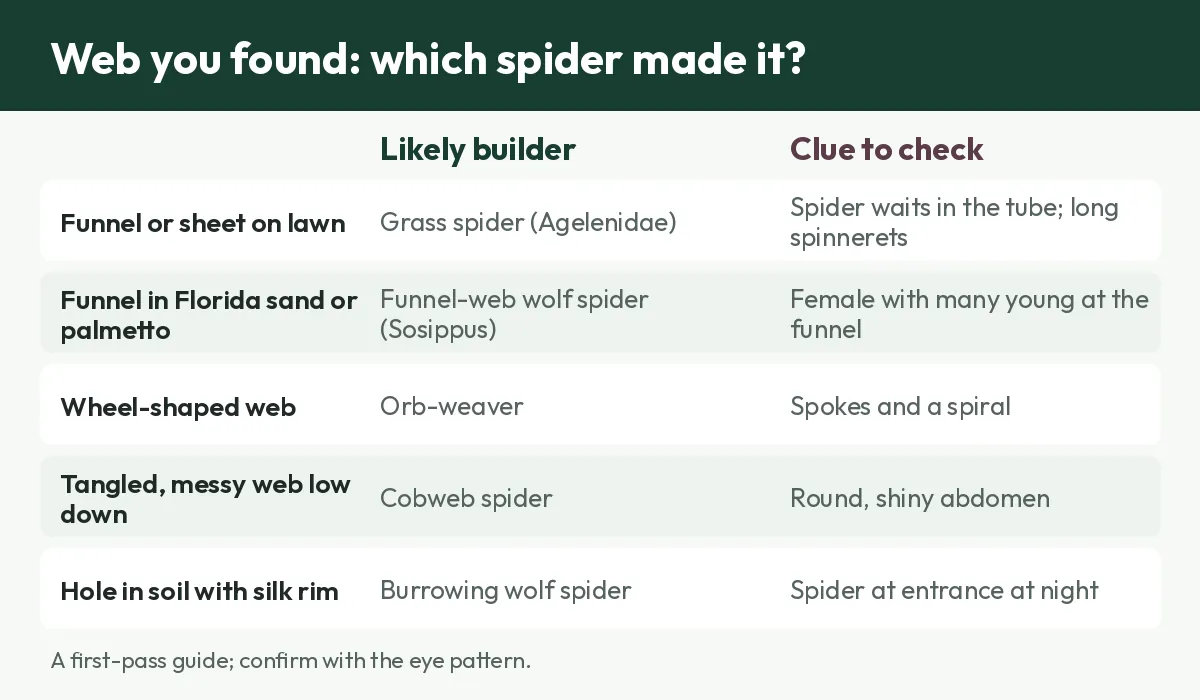
Use the web type as your first clue, then confirm with the spider itself. Our web-type table covers more web styles.
Related Guides
- What Do Wolf Spiders Eat? Prey, Hunting and Pest Control
- Are Orb Weaver Spiders Poisonous? What a Bite Really Does
- How to Identify a Brown Recluse Spider: The 5-Point Check
- How Long Do Spiders Live? Lifespans by Spider Type
- Can Jumping Spiders Bite? What Happens and How Rare It Is
- Are Huntsman Spiders Poisonous? Bite Facts for U.S. Homes
- What Do Tarantulas Eat? Wild U.S. Diet, Rare Prey and Pet Care
- Six-Spotted Fishing Spider: How Dolomedes triton Hunts on Water
- Spider types: six common groups compared
- How to identify a spider in five steps
- Spider facts with sources
- All SpiderNexa articles
Frequently Asked Questions
Do wolf spiders spin webs at all?
They spin silk, but not capture webs. Wolf spiders use silk for draglines, burrow linings, egg sacs and retreats. Only a few web-building groups, such as Sosippus in the southeastern U.S., spin true webs.
Why is there a web where I saw a wolf spider?
The web probably belongs to another spider. Grass spiders, sheet-web weavers and cobweb spiders often live in the same places, and wolf spiders may walk across their webs.
Do wolf spiders live in burrows?
Many do. Some species dig vertical burrows lined with silk, and some add a turret of sticks and debris at the entrance. Others simply hide under rocks, logs or leaf litter.
Is a funnel web wolf spider dangerous?
No evidence suggests it is. Like other wolf spiders, it is shy and bites only if handled or trapped. A wolf spider bite usually causes mild local pain and redness.
References
- Wolf Spiders – Missouri Department of Conservation
- Identification Guide to Common Spiders in Nebraska (EC1590) – University of Nebraska–Lincoln Extension
- Punzo & Haines (2006), Body size, development and mother–offspring interaction in Sosippus floridanus – Bulletin of the British Arachnological Society
- Habitat associations of the web-building wolf spiders Sosippus floridanus and S. placidus – Journal of Arachnology
- Wolf Spiders: Family Lycosidae – Montana State University Urban IPM